Reforming lectio divina

Spirituality is still a huge topic with evangelical Christians, and increasingly practices such as lectio divina are encouraged even for Reformed Christians. But is this practice helpful? And how can it be used by Christians in the Reformed tradition?

Lectio divina (or, divine reading) as described by Kenneth Boa in his book Conformed to His Image, (Zondervan, 2001), 96-97.

The ancient art of lectio divina, or sacred reading, was introduced to the West by the Eastern desert father John Cassian early in the fifth century.

It consists of four elements.

  1. Lectio (reading). Select a very short text and ingest it by reading it several times. Normally, one chooses a verse or a brief passage from the chapters read from the Old and New Testaments in morning Bible reading.
  2. Meditatio (meditation). Take a few minutes to reflect on the words and phrases in the text you have read. Ponder the passage by asking questions and using your imagination.
  3. Oratio (prayer). Having internalized the passage, offer it back to God in the form of personalized prayer.
  4. Contemplatio (contemplation). For the most of us, this will be the most difficult part, since it consists of silence and yieldedness in the presence of God. Contemplation is the fruit of the dialogue of the first three elements; it is the communion that is born out of our reception of divine truth in our hearts.

I think there is much to appreciate about lectio divina, especially its Agassiz-like focus on a text. Further, that Scripture ought to bid us pray and that our prayers ought to be filled with Scripture is an axiom of this discipline, so to the extent that the lectio divina encourages this is a boon. I would even go so far as to say – due to the importance of prayer in the Christian life – that anything that encourages prayer in the life of believers is a good thing. But having said all of this, let me turn to a few concerns. Continue reading

The Problem with Most Bible Studies

You know that feeling you get when someone perfectly describes something you have witnessed or seen dozens of times, but never been able to articulate yourself? I had that feeling as I listened to Christian Smith describe the average, American Evangelical Bible study. The following quote is taken from an interview at The White Horse Inn:

Basically, what gets reported [by anthropologists studying evangelical Bible studies], and what I think I agree with, is:
The text is read, umm… what the text actually says is not all that much paid attention to. People, rather, sort of search around in their heads and their memories and their feelings for something that seems to connect to the text. And then, they conclude, “Oh yeah, well that makes me feel like this…” or, “What I think is that…” or, “In my opinion what it means is this…” And usually, the text is serving as a pretext to affirm something they already believe, rather than as an authoritative text to challenge what they already believe.

Nailed it.

The Athenian Creed

What is the Athenian Creed? Perhaps it is one of the post-Refomration creeds newly republished thanks to Dennison’s or Van Dixhoorn’s work? Or perhaps it is merely an example of Old Side Presbyterianism skewering unbelief and modernism within the Church? If you’re leaning toward the latter, you’d be spot on.

Recently, over at WHI, Mike Horton highlighted the satire that John Witherspoon used to skewer the modernists and Moderates in the Kirk of Scotland. His Ecclesiastical Characteristics, divided into certain “Maxims,” were a hot iron toward his liberal contemporaries.

One such Maxim was his “creed,” a lampooning article of what he considered to be the reigning ideology of the day. Continue reading

Just In Case You Missed ‘Em

With the overwhelming influx of information available, discerning readers must become selective in what they give their time to read. Just in case you missed ‘em, here are some links I found valuable, and hope you will also.

Horton’s Recent Chapter on Scripture
Dr. Rev. Michael S. Horton contributed to Christian Theologies of Scripture: A Comparative Introduction with his chapter “Theologies of Scripture in the Reformation and Counter-Reformation: An Introduction.” Download it from the link above.

Before Rob Bell, There Was David Swing
PCA pastor-scholar Sean Lucas reminds us of the liberalizing David Swing, and why the most popular pastor of the biggest church in Chicago is no longer there.
Continue reading

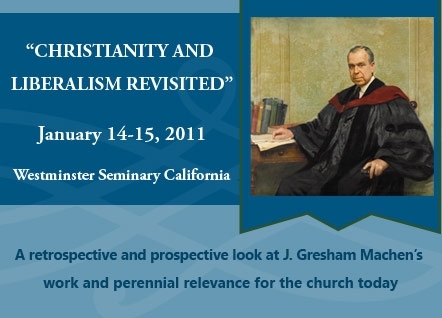
WSC: Christianity & Liberalism Revisited


The annual conference held at Westminster Seminary, CA this year is “Christianity & Liberalism Revisited: A retrospective and prospective.” The title derives from J. Gresham Machen’s 1923 monograph which maintained that liberal Christianity was not, in point of fact, Christian at all. Machen, who would go on to establish Westminster Theological Seminary, became an important figure for confessional Christianity in the face of liberalizing tendencies. By looking backward and forward, this conference looks like a fascinating opportunity to contemplate where confessional Christianity is facing challenges and what, if anything, may be done about it. You can find out all the details at their site.

Wishing you could hear this amazing conference but can’t swing out to SoCal for the weekend? Never fear! WSC is graciously hosting the event live, and you can watch the live stream here. I’ve got my connection all warmed up. The first session begins tonight (Jan 14) at 7pm (Pacific Time).

Schedule
“Christianity and Liberalism Today” –Michael S. Horton
“The Perennial Machen” –D.G. Hart
“Machen and the Bible” –Joel. E. Kim
“Machen and the Gospel” –J.V. Fesko
“Machen and Ethics” –David VanDrunen
“Machen, Christianity, and the Church” –W. Robert Godfrey
“Q & A” -Faculty

Looks like I’ve got my viewing pleasures all mapped out for the next two days. Will you be watching?