Liberal, ahistorical Scholastics?

Leithart comments:

In a Mars Hill Audio interview, Ellen Charry observes that the Protestant theologians of the seventeenth century, even before the Enlightenment, had a tendency to detach truth from historical reference. The truth of theology was seen in the coherence of the system of truth found in Scripture, rather than a truth of reference to historical events.

Charry’s comment was a passing one, no doubt a drastic oversimplification. Protestant scholastics, after all, defended the historical reliability of Scripture as well as its systematic coherence. But, the comment seems worthy of investigation, since it might provide a historical link between Protestant scholasticism and the development of liberal theology.

Maybe there is some truth to this claim, especially since “the Protestant theologians of the seventeenth century” (no reference to confessional position, orthodoxy, etc.) is a pretty wide generalization. I didn’t listen to the interview, and like Leithart noted, it was a passing comment.

That said, there are important nuances to this idea. If by “Protestant theologians of the seventeenth century” one is referring to Reformed Scholastics like Cocceius, Voetius, Brakel, Turretin, Owen, or Witsius, then qualifications should be noted. These qualifications follow in patterns that we, and Charry?, may not quickly set upon. First, the scholastics (and Protestant scholastic era) were some of the best with historically-referent theology, and secondly, despite their connections with history, some of these theologians were quickest into the liberal slide. Continue reading
Be Careful How You Hear

Dear Zion,

One of the things a pastor and a congregation spend a lot of time on together is the sermon that is preached every Lord’s Day in the worship service. The minister spends time preparing and delivering the message, and the congregation spends time hearing it and living their lives based off of it. But have you ever thought about how to hear a sermon? How can we obey Jesus’ command to “be careful how you hear” (Luke 8:18)? Consider a few ideas with me:

  • Believers should prepare themselves to hear. The Apostle Peter commands that we “desire the sincere milk of the Word like newborn babies,” and that one of the ways we prepare that spiritual “thirst” within us for God’s Word is by laying aside all sin (I Peter 2:1 – 2). Sin acts like wax in our ears, and keeps us from hearing the life-giving words we so desperately need. Do not allow Saturday night – or the week before Sunday – as an opportunity for sin, but instead lay aside sin by faith and focus on “thirsting” to hear from the Lord in the sermon.
  • Believers should prepare through prayer. Continue reading

Redemptive Historical Preaching: Christ at the Center

Download file

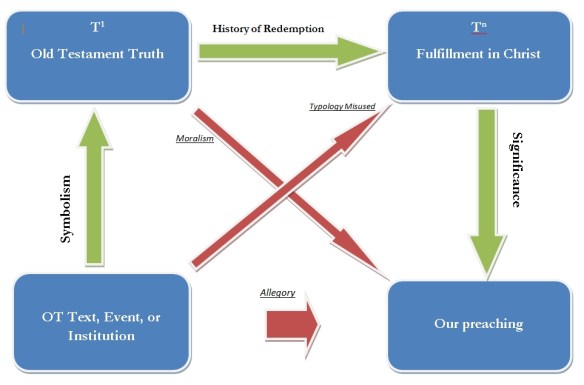
One concept that is so helpful to have when considering how to exhort God’s people from God’s Word is that our preaching must be Christ-centered. The idea that Scripture isn’t just a book of timeless truths, morality plays, or helpful advice for living, but is instead one grand narrative displaying the promise of, the coming of, and the rule of the Messiah Jesus, has been thoroughly covered by men much better than I, most notably Ed Clowney, Sidney Greidanus, Dennis Johnson, and Graeme Goldsworthy. Their articles and books are most helpful. But occasionally, just having a handy chart around can jog your mind in the specifics.

The above chart can be downloaded here. It is a rough adaption of what Dennis Johnson adapted from Ed Clowney. I’ll try to briefly explain what the chart says, as well as how to use it below. Continue reading

St. Bartholomew’s Day Massacre

On August 24, 1572, one of the more tragic events occurred in the wars of religion throughout France. Especially within Paris, France, tensions between the Papist Parisians (the majority) and the French nobility and laity that held to the Reformed faith – referred to as Huguenots – were at a premium. After a failed assassination attempt on Admiral de Coligny, a noted Reformed Christian, on August 22, the animosity reached an all time high.

The Huguenot Cross

Catherine de Medici was the queen mother, and by urging her son Charles IX that Reformed Huguenots were a political threat to the stability of Paris and France, de Coligny was assassinated just before dawn on August 24. Following his death, rioting broke out in Paris, which then swept through the country, where neighbor turned on neighbor, and the Catholic majority looted and murdered their Reformed countrymen in a tragic event for the Reformed faith. Continue reading

Monday Morning Pulpit: Judging

Sometimes you run out of room or time in your Lord’s Day sermon, and so “Monday Morning Pulpit” is a chance to expand upon or reinforce ideas you didn’t have a chance to finish during the sermon.

We wrapped up a short, topical series on God’s Judgments and Judging at Zion Ev. & Reformed Church. Especially in the second sermon in the series, we looked at what it means for God to Judge of all the earth (Genesis 18:25; Psalm 50:1 – 6). After demonstrating his judgments in Creation by issuing divine decrees on His own handiwork (“it was good,” “it was very good”) God shows His just judgments in salvation history. God’s judgment climaxes in condemning our sin at the cross, and vindicating Christ at His resurrection (Romans 4:25; I Timothy 3:16), and thus pronouncing us to be justified by faith in Christ (Romans 8:1).

Since God is Judge, how then should we live?

Since God is Judge,

then let us judge ourselves before judging others. Continue reading

Dear Pastor: Straight Talk on Hell

Dear Pastor,
This article was sent to me from a friend who does not believe in hell. He believes a loving father would never send His child to hell is what . I know he sent this to me because he knows I do believe in hell. How do I respond in a clear fashion?
Thanks,
[redacted]

You asked about the article that was sent to you, written by an author named Oliver Thomas. In the article, he makes some claims in the article that I want to point out, and then I’ll give you a few thoughts on how you should speak to your friend about this, as well as some resources that are available to help you. But first, let’s examine some of the author’s claims:

Hell in the Old Testament
1. Does the Old Testament teach everlasting punishment after death? The author of the article says, “Nowhere in the Hebrew Bible (Christian Old Testament) is the abode of the dead described as a place of eternal punishment.” The article is quite correct, in that the most common description of what awaited people after death was known as sheol, a shadowy, uncertain place. Both godly, righteous people and the wicked ended up in sheol. But sheol has a few different meanings in the Old Testament, and the author is ignoring parts of what the Bible says. Continue reading

Citizens of the Coming Kingdom

Dear Zion,

One of the main themes of Jesus’ teaching during His earthly ministry was the Kingdom of God. As soon as He began His ministry, “Jesus came proclaiming the gospel of God… ‘the kingdom of God is at hand; repent and believe in the gospel'” (Mark 1:15). When He sent out His disciples, their message was similar: “These twelve Jesus sent out, instructing them to proclaim as you go, saying, ‘The kingdom of heaven is at hand‘” (Matthew 10:5). After Jesus ascended into heaven, the disciples continued to “preach the good news of the kingdom of God and the name of Jesus Christ” (Acts 8:12), and even at the end of the apostolic age we see the apostle Paul basing his teaching on the Kingdom (Acts 28:30 – 31). But what is the Kingdom, and how can we be servants of the Kingdom in this world?

The first concept to understand is that the Kingdom is God’s realm where He rules as almighty sovereign. Continue reading

A Father to the Fatherless

One of the ladies in our congregation recently lost her father, and in counseling and encouraging her, I’m reminded of what the great American pastor and theologian Jonathan Edwards (1703 – 58) wrote. Having contracted smallpox through a botched innoculation, Edwards wrote to his daughter the last words of his that we have.

And as to my children, you are now to be left fatherless, which I hope will be an inducement to you all to seek a Father who will never fail you.

Jesus says in Matthew 19:29:

And everyone who loses houses or brothers or sisters or father or mother or children or lands, for my name’s sake, will receive a hundredfold and will inherit eternal life.

Amen. May it be so for all of us.

Firefox 5 or Chrome 12


I just recently upgraded to Firefox 5, but I use Chrome a lot as well. Which is better? Firefox has been touted for its performance, add-ons, etc., for years, but recently many people have been championing turning over to Chrome. Here’s the most recent contest I could find:

Google Chrome 12 performs really well with many JavaScript functions according to benchmarks used in this post. HTML 5 video benchmark and CSS 3D hardware acceleration works incredibly well, also you can check HTML 5 video experiment for shaun the sheep in this post Here. Google chrome uses a separated memory usage for each tab and google extensions but overall after comparing it with firefox it require more memory with running same number to tabs.

Mozilla Firefox 5 benchmark scores looks really low compared to firefox [Ed note: I think he means Chrome?] scores even though it was performing quite good with same benchmark tools specially for compiling JavaScript with taking advantage of your CPU and RAM. Firefox 5 does not require a lot of memory usage.

Find all the details here.

Calvin’s Ecclesiastical Ordinances

The Genevan Book of Order

The Form of Prayers and Ministration of the Sacraments, etc.
Used in the English Congregation at Geneva (1556)

Of Ministers and Their Election
What Things are Chiefly Required in the Pastors and Ministers

First, let the church diligently consider that the minister which is to be chosen[a] be not found culpable of any such faults which St. Paul reprehends in a man of that vocation,[b] but contrariwise endowed with such virtues, that he may be able to undertake his charge, and diligently execute the same. Secondly, that he distribute faithfully the word of God, and minister the sacraments sincerely,[c] ever careful not only to teach his flock publicly, but also privately to admonish them;[d] remembering always, that if any thing perish through his default, the Lord will require it at his hands.[e]

a. Acts 1:21-23; 13:2-3; 14:23 Continue reading