Logos March Madness

Logos – tagging along with another March Madness – has rigged up a fun tourney that lets you vote for your favorite theologians and pastors. Here’s my brackets:I realized as I was filling out the bracket that this was basically a popularity contest, and that I was heavily favoring Reformed and pastors over evangelical and scholars. There were some pretty difficult decisions. How do you pick between Owen and Calvin?! Continue reading
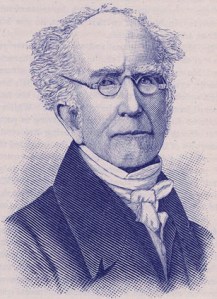
Select Works of Samuel Miller (1769 – 1850)

Recently, I came across Miller’s Thoughts on Public Prayer, and was greatly helped. I knew Miller to be a staunch Old School Presbyterian, and so I wondered what else of his I could find online for free. Turns out, pretty much everything he wrote is at Google Books. Help yourself!

UPDATE: The original post was by no means exhaustive, but thankfully the PCA Historical Center already had compiled the Samuel Miller Collection. While there aren’t many links at the Collection, there is a complete bibliography listed. I was reminded of this by The Confessional Presbyterian which points this resource out.

A Brief Retrospect of the Eighteenth Century (1803, 1805)

A Sermon on Lamentations 2:1, 13 (1812)

An Able and Faithful Ministry (1812)

Memoir of the Reverend John Rogers (1813)

Letters on Unitarianism (1821)

Letter on Christmas Observance (1825) Continue reading

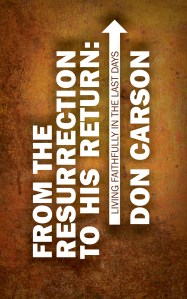
Review: From the Resurrection to His Return

D.A. Carson From the Resurrection to His Return: Living Faithfully in the Last Days (Christian Focus, 2010)
Kindle publication at Amazon
Paperback at WTS Books

(this review looks at the unpaginated eBook version)

Christian Focus has published another brief but useful classic from Dr. Carson on II Timothy. The subject of “end times,” or even more dauntingly – eschatology, brings confusion for many, but Carson treats the heart of the matter: living faithfully for Christ in these last days. More information on the book can be found at The Gospel Coalition (though I myself did not have access to it at the time of the review). Carson’s book is an accessible guide for Christians unto faithful living packed with simple but gripping lessons, that is recommended for anyone.

Overview

Chapter 1, “Living in the Last Days,” is a smooth, concise, running commentary of prose on II Timothy 3:1 – 9. The entire text of 2 Timothy 3 – 4:6 appears just before, but without a note of explanation. Nowhere are you alerted to what this book is: a commentary? devotionals? summary? Despite a disorienting beginning, Carson’s insights into the text are engaging and helpful. Unlike the rocky beginning, the remaining chapters easily flow into one another. Continue reading

Presbyterian Public Prayer

Few have the Old School street cred of Samuel Miller (1769 – 1850). And I recently discovered his Thoughts on Public Prayer, which can be
downloaded from Google Books here.

There are probably some important connections to think about between the relative paucity of congregational prayer in much of American Christianity, and how modern American Christian worship/entertainment is a descendant of New School ideas run wild. So the fact that you need to go to an Old School Presbyterian to think carefully about public prayer should probably be a no brainer, but I’ve been encouraged nonetheless.

Should the congregation face east for prayer (especially when that practice was so common in the ancient church)? What posture or liturgy best suits corporate prayer? Acknowledging that prayer is not mechanistic, but a Spiritually-derived communion of the soul with the Almighty, what steps or means – if any – may be taken to travel towards excellence in our prayer ministry? These questions, and so much more, is for free in Miller’s Thoughts on Public Prayer. Download it now!

W.H. Auden’s Birthday

Funeral

Stop all the clocks, cut off the telephone,
Prevent the dog from barking with a juicy bone,
Silence the pianos and with muffled drum
Bring out the coffin, let the mourners come.

Let aeroplanes circle moaning overhead
Scribbling on the sky the message He Is Dead,
Put crêpe bows round the white necks of the public
doves,
Let the traffic policemen wear black cotton gloves.

He was my North, my South, my East and West, Continue reading

Samuel Miller – An Able and Faithful Ministry

The following article by Samuel Miller was made available by Presbyterian Heritage Publications. As the website hosting this article expired, I’ve copied it here. The archived webpage may be accessed here.


This sermon was published under the title of The Duty of the Church to Take Measures for Providing an Able and Faithful Ministry, included in a larger publication, The Sermon, Delivered at the Inauguration of the Rev. Archibald Alexander, D.D. Professor of Didactic and Polemic Theology, in the Theological Seminary of the Presbyterian Church, in the United States of America: to Which are Added, the Professor’s Inauguration Address, and the Charge to the Professor and Students (New York: Whiting and Watson, 1812).

Copyright © 1987 by
Presbyterian Heritage Publications
Second Edition, 1994

The electronic version of this document has been provided as a convenience for our readers. No part of this publication may be transmitted or distributed in any form, or by any means (electronic, mechanical photocopying, or otherwise) without prior permission of the publisher. Inquiries may be directed to: Presbyterian Heritage Publications, P.O. Box 180922, Dallas, Texas 75218, U.S.A. Please write to the publisher for more details about our other publications.


An Able and Faithful Ministry

Samuel Miller

“And the things that thou hast heard of me among many witnesses, the same commit thou to faithful men, who shall be able to teach others also.”
2 Timothy 2:2

The apostle Paul received both his knowledge of the gospel, and his commission to preach it, immediately from the great Head of the church. Yet, notwithstanding the extraordinary circumstances which attended his theological instruction, and his official investiture, that “all things might be done decently and in order” (cf. 1 Cor. 14:40), he submitted to “the laying on of the hands of the presbytery” (1 Tim. 4:14; cf. Acts 13:3), before he went forth on his great mission to the Gentiles. In like manner, Timothy, his “own son in the faith” (1 Tim. 1:2), to whom the exhortation before us is addressed, was set apart to the work of the holy ministry, by the presbytery,­ in which body, on that occasion, the apostle himself seems to have presided (cf. 2 Tim. 1:6).

Timothy was now at Ephesus; and being the most active and influential member of the presbytery which was constituted in that part of the church, his spiritual father directed to him, as such (and in him to the church in all succeeding times), the rules and instructions contained in the epistles which bear his name. Among these we find the passage which has just been read: “And the things that thou hast heard of me among many witnesses, the same commit thou to faithful men, who shall be able to teach others also” (cf. 2 Tim. 1:6) Continue reading

A Concise Argument for Definite Atonement

The following is a summary of the classic argument put forward by John Owen in The Death of Death in the Death of Christ

_____________________
The Father imposed His wrath due unto, and the Son underwent punishment for, either:

  1. All the sins of all men.
  2. All the sins of some men, or
  3. Some of the sins of all men.

In which case it may be said:

  1. That if the last be true, all men have some sins to answer for, and so, none are saved.
  2. That if the second be true, then Christ, in their stead suffered for all the sins of all the elect in the whole world, and this is the truth.
  3. But if the first be the case, why are not all men free from the punishment due unto their sins?

You answer, “Because of unbelief.”

I ask, Is this unbelief a sin, or is it not? If it be, then Christ suffered the punishment due unto it, or He did not. If He did, why must that hinder them more than their other sins for which He died? If He did not, He did not die for all their sins!”

Awesome Aussie Finals

Super excited for the upcoming Australian Open men’s final on Saturday, between #1 ranked Novak Djokovic and #2 Rafael Nadal. As this is a consistent rematch, it promises to make some great tennis.

Djokovic is coming off a once-in-a-lifetime 2011, putting up numbers that seem inconceivable. I was watching SportCenter’s pre-final coverage, and they put up a stat that showed Nadal beating Djokovic nearly 2 to 1. I had to chuckle at that “fact,” since those numbers don’t clearly display how completely dominated Nadal has been since Djokovic entered his top-level tennis a few years back. Nadal himself even admitted that Djoker was in his head, and he looked very anguished at the losses he’s been taking from the new #1.

I do hope Djoker wins, and I think he has the tools, ammo, and skill to do it. I can’t say I’ve ever been a huge fan of Rafa, but if there is a way for him to beat Djokovic, I’m convinced Rafa will find it. Even if you don’t care for any other part of Nadal’s game, his careful studies – first to learn to take down Federer – put him in a category where nothing seems to outwit him for long. I wouldn’t be terribly surprised if Nadal had concocted some new game plan to take revenge for his previous year’s losses.

Either way, should be great tennis.

Abigail Adams on Slavery and Union

I’ve finished David McCullough’s riveting John Adams, and I’m continuously struck by Adams moral fortitude, discipline, and character as he fulfilled a variety of economic and political roles in the birth pangs of America. I’ve been especially intrigued by McCullough’s differentiation between Adams’ view of America – land-owning, thrify, plain, honest, pious, and somewhat rural – and Thomas Jefferson’s view – slave-owning, indebted, lavish, cosmopolitan, and Enlightened. Surely there are generalities here, but it has been fascinating nonetheless, and I hope to reflect more on it in the future.

Abigail Adams, wife to the second President, was known as an emotional and intellectual symbiote for Adams, the “ballast in his ship.” I was struck by her words in a letter to her sister:

I firmly believe, that if I live ten years longer, I shall see a division of the Southern and Northern states, unless more candor and less intrigue, of which I have no hopes, should prevail. (p. 434)

What is most striking is to remember that Abigail was writing in 1792, seventy-three years before the Civil War would end. Further, before a trip to France when John was the foreign minister there, Abigail had never set foot outside of her county, and travel terrified her. That leads me to conclude that the well-read Mrs. Adams had not only read of the differences between North and South, but some of her experiences with Southern gentlemen & ladies led her to a fairly certain conviction. The context doesn’t appear to be only, or merely, slavery; but also various forms of other cultural differences.

Clearly, the “War Between the States” was addressing differences that were a long time in coming.

Sovereignty, Providence, and Good Works in 2012

Dear Zion,

There’s no use denying it any longer: 2012 is here! As we enter into this “New Year,” all sorts of new experiences come with it: new hopes and new fears for what the new year may bring; new possibilities – as well as the feelings of regret and loss that can come as time marches on. With all of the unknowns in the future, feelings of anxiety, fear, curiosity, or hope can settle into all of our hearts. But no matter what 2012 brings with it for good or for bad, Christians have a rock-solid confidence in two important doctrines: God’s sovereignty over 2012, and God’s providence for 2012.

The Sovereignty of God over 2012
No matter what the new year brings, we can be sure of this: God is in control of 2012. All times are in His hand, and since He is the Alpha and the Omega, the First and the Last (Revelation 1:8), we know that He makes the ends known from the beginning (Isaiah 46:10). Every day that we live in 2012 has already been written in His book (Psalm 139:16), and nothing that happens to us can happen apart from His will. Life and death, health and sickness are in His hands (Deuteronomy 32:39). Neither a sparrow (Matthew 10:29 – 31) nor a hair from your head (Luke 21:16 – 18) can fall apart from God’s will. So for those who love God and are called according to His purpose, the future of the new year doesn’t need to be a scary thing, because He has promised that all things will work together for our good (Romans 8:28). As we make our plans for 2012, we should recognize God’s absolute power and control over all the decisions we make, and ultimately entrust ourselves and our plans to Him (James 4:13 – 17).

The Providence of God for 2012 Continue reading