Partisan Politics Can Destroy Your Faith

Do you know the political zealot, whose faith in Christ has taken a back seat to faith in “the Cause?” The one who’s love for Him who is “the Name above all names,” now only gets excited for the Nation?

It starts subtly. Disappointment over the pandemic. Distrust in our institutions. A compromised church. Illegal actions in law enforcement. The faith delivered once for all helps you see political connections, and partisan challenges. After all, you think, its important to live out your faith in every sphere of life, including partisan politics, right?

But soon the political inferences that came from your faith take the driver’s seat, and the daily devotional or private worship is replaced with the daily rally cry and public call to action.

In his fictional The Screwtape Letters (1942), C.S. Lewis literally plays devil’s advocate, penning fictive letters from a senior demon (“Screwtape”) to his junior colleague of evil (“Wormwood”). The goal of these letters is to undermine a Christian individual that Wormwood is hopelessly attempting to lead astray. The “Enemy” is God, according to these demons, “the patient” is the teetering Christian, and making the patient “ours” is tantamount to bringing him to hell. The following letter on politics, extreme factions, and letting faith become a means to a political end, are right on point. “My dearest Wormwood…”

I had not forgotten my promise to consider whether we should make the patient an extreme patriot or an extreme pacifist. All extremes, except extreme devotion to the Enemy, are to be encouraged. Not always, of course, but at this period. Some ages are lukewarm and complacent, and then it is our business to soothe them yet faster asleep. Other ages, of which the present is one, are unbalanced and prone to faction, and it is our business to inflame them…

Continue reading

Witherspoon: The Spiritual Condition Is More Important Than Our Earthly Status

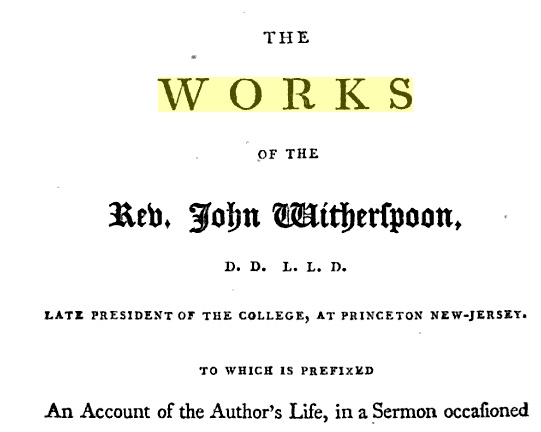
John Witherspoon (1723-1794) was a key Presbyterian minister during the Revolutionary War period in American history, and is regarded among the Founding Fathers. As the only active clergy to sign the Declaration of Independence, to sign the Articles of Confederation, approve the Constitution, and serve as Moderator of the General Assembly for American Presbyterians, Witherspoon established himself in sacred and secular history of this nation. He has an important treatise on the doctrine of being born again, or regeneration.

Witherspoon wrote movingly about preaching the Gospel to different socio-economic groups, especially the poor. Here is a longer passage, where after addressing the unique situation the Scriptures give to those suffering in poverty, he says:

But does not the Savior of sinners beseech you to be reconciled unto God? He entreats you to come unto Him that you may have life. He regardeth not the persons of men, but values a precious immortal spirit as much in a mean cottage as in a splendid palace. Your rags and nakedness can be no hindrance to your obtaining His favor. He counsels you “to buy of Him gold tried in the fire, that you may be rich, and white rainment that you may be clothed.”

Continue reading

The Athenian Creed

What is the Athenian Creed? Perhaps it is one of the post-Refomration creeds newly republished thanks to Dennison’s or Van Dixhoorn’s work? Or perhaps it is merely an example of Old Side Presbyterianism skewering unbelief and modernism within the Church? If you’re leaning toward the latter, you’d be spot on.

Recently, over at WHI, Mike Horton highlighted the satire that John Witherspoon used to skewer the modernists and Moderates in the Kirk of Scotland. His Ecclesiastical Characteristics, divided into certain “Maxims,” were a hot iron toward his liberal contemporaries.

One such Maxim was his “creed,” a lampooning article of what he considered to be the reigning ideology of the day. Continue reading

Resources on Regeneration

I’m hoping to do some extended thinking (and preaching?!) on regeneration in the next few weeks/months, and I was thinking I should line up a list for reading and meditating on this important doctrine. Unfortunately, it can be a little difficult to find extended discourses on the topic of regeneration. I attribute that to a variety of factors:

    • In the history of doctrine, regeneration has been something of a moving target, especially for Calvin’s successors, where regeneration can mean anything from conversion, repentance, sanctification, or the newer clarification of speaking exclusively of the (initiation of) spiritual life.

Continue reading