
Tag Archives: piety
Monday Morning Pulpit: Judging
Reply
 Sometimes you run out of room or time in your Lord’s Day sermon, and so “Monday Morning Pulpit” is a chance to expand upon or reinforce ideas you didn’t have a chance to finish during the sermon.
We wrapped up a short, topical series on God’s Judgments and Judging at Zion Ev. & Reformed Church. Especially in the second sermon in the series, we looked at what it means for God to Judge of all the earth (Genesis 18:25; Psalm 50:1 – 6). After demonstrating his judgments in Creation by issuing divine decrees on His own handiwork (“it was good,” “it was very good”) God shows His just judgments in salvation history. God’s judgment climaxes in condemning our sin at the cross, and vindicating Christ at His resurrection (Romans 4:25; I Timothy 3:16), and thus pronouncing us to be justified by faith in Christ (Romans 8:1).
Since God is Judge, how then should we live?
Since God is Judge,
then let us judge ourselves before judging others. Continue reading
Bonhoeffer on Cheap Grace
The following are large quotes and snippets from Bonhoeffer’s Cost of Discipleship, pages 45 – 49. A few thoughts afterward.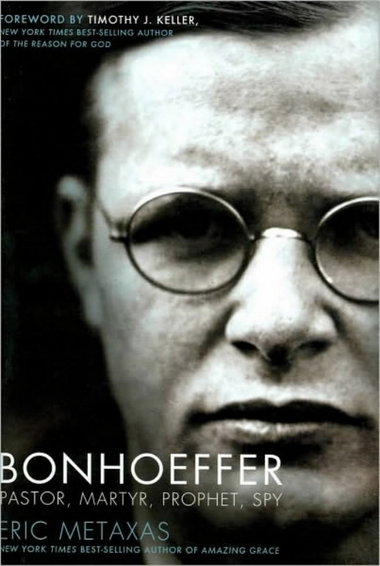
“Cheap grace is the deadly enemy of our Church. We are fighting today for costly grace… Cheap grace means grace as a doctrine, a principle, a system. It means forgiveness of sins proclaimed as a general truth, the love of God taught as the Christian ‘conception’ of God. An intellectual assent to that idea is held to be of itself sufficient to secure remission of sins…. In such a Church the world finds a cheap covering for its sins; no contrition is required, still less any real desire to be delivered from sin. Cheap grace therefore amounts to a denial of the living Word of God, in fact, a denial of the Incarnation of the Word of God.
“Cheap grace means the justification of sin without the justification of the sinner. Grace alone does everything they say, and so everything can remain as it was before. ‘All for sin could not atone.’ Well, then, let the Christian live like the rest of the world, let him model himself on the world’s standards in every sphere of life, and not presumptuously aspire to live a different life under grace from his old life under sin…. Continue reading
Just In Case You Missed ‘Em
With the overwhelming influx of information available, discerning readers must become selective in what they give their time to read. Just in case you missed ’em, here are some links I found valuable, and hope you will also.
NYT: The High Cost of Low Teacher Salaries
Being the husband of an amazing teacher, this issue strikes close to home. Why does the entertainment business (pro sports, musicians, Hollywood) command multi-billion dollar industries, but our most formative is nearly broke? I think R.C. Sproul once argued that educators’ compensation reveals a culture’s priorities.
Ligonier: What about “Church is boring?”
When we come into the presence of the Almighty, we come as embodied souls, and there is nothing boring about meeting with the Ancient of Days.
Michael Gerson critiques Ron Paul’s Libertarianism Continue reading
Sanctification: Ryle vs. Pink?
What role does sanctification play in the Christian life? And specifically, is sanctification necessary for a Christian to ultimately be saved? Sometimes this issue can be confusing for Reformed Protestants who wish to maintain salvation by God’s saving grace from first to last, and yet also trumpet the need for holiness and good works. Even reading erstwhile helpful pastors and expositors can be confusing, as J.C. Ryle and Arthur W. Pink demonstrate. Consider their separate comments:

From bottom left going clockwise: Ryle, Pink, Owen, Calvin
J.C. Ryle- “Holiness” pg.28-29
“Sanctification, in the last place, is absolutely necessary, in order to train and prepare us for heaven Continue reading
Link
Just In Case You Missed ‘Em
With the overwhelming influx of information available, discerning readers must become selective in what they give their time to read. Just in case you missed ’em, here are some links I found valuable, and hope you will also.
Resources for Holy WeekThe Week Before Christ DiedLigonier Ministries collates a large repository of resources for considering Christ’s active and passive obedience up to the cross. Audio, articles, a few videos, and resources from other well known pastors as well.
Sowell: Is Bullying for Real?
One of the clearer thinkers in America today examines what is happening in our schools, what we should think, and what may be done about it. For those of you who are teachers or witnesses to bullying (in person or cyber), how does Sowell’s conclusions sit with you? Is there accuracy? Continue reading
Disagreeing with Calvin
…is not wise to do very often, but it is important. It is not wise, because so often Calvin proves to be right. I can remember Bob Godrey, president of Westminster Seminary CA, talking about how the older he got, the more often he found Calvin to be proven to be correct on various exegetical, theological, or ecclesiastical issues. David Steinmetz has talked about the superiority of pre-critical exegesis, and Calvin’s reflections are remarkably biblical and pastoral. It is rarely wise to disagree with the Reformer.
But it is also important to be able to disagree with Calvin. Continue reading
Godliness In Selecting Worship Music
Dear Zion,
As we seek to obey God’s Word in the realm of music in worship, we must remember that there are several commands in God’s Word that do not speak directly to music, but nevertheless apply to how we treat one another. In this article, we will look at some of these biblical principles. Continue reading
Link
 Tullian: “I hear people say that there are two equal dangers Christians must avoid: legalism and lawlessness. Legalism, they say, happens when you focus too much on law, or rules. Lawlessness, they say, happens when you focus too much on grace. Therefore, in order to maintain spiritual equilibrium, you have to balance law and grace. Legalism and lawlessness are typically presented as two ditches on either side of the Gospel that we must avoid. If you start getting too much law, you need to balance it with grace. Too much grace, you need to balance it with law. But I’ve come to believe that this “balanced” way of framing the issue can unwittingly keep us from really understanding the gospel of grace in all of its depth and beauty.”
 Brian J. Lund