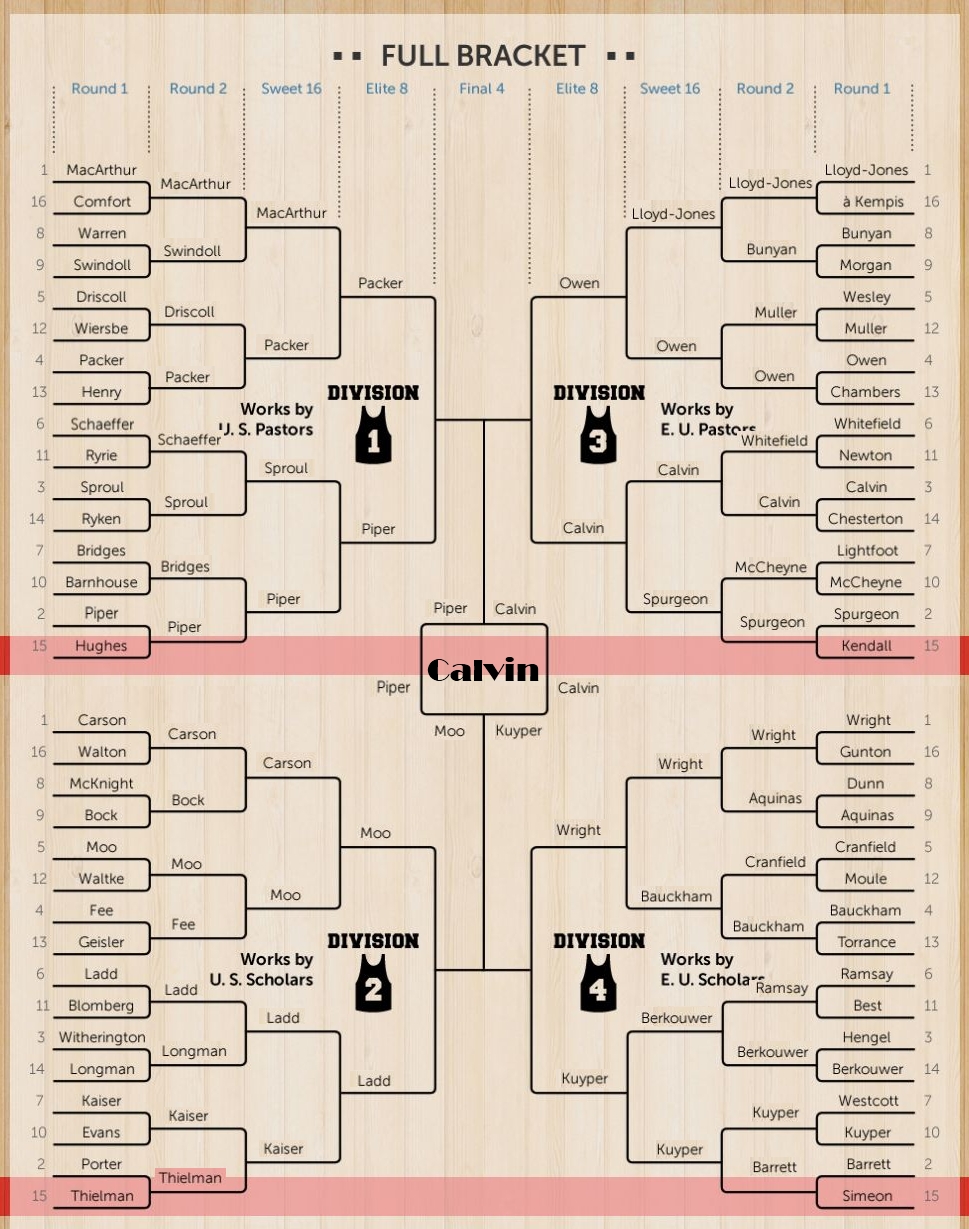
Logos – tagging along with another March Madness – has rigged up a fun tourney that lets you vote for your favorite theologians and pastors. Here’s my brackets:
I realized as I was filling out the bracket that this was basically a popularity contest, and that I was heavily favoring Reformed and pastors over evangelical and scholars. There were some pretty difficult decisions. How do you pick between Owen and Calvin?! Continue reading
Tag Archives: Calvin
Calvin on Allah & Idolatry
I’ve looked at the claims of inclusivism, universalism, and exclusivism before, but sometimes the nature Allah confuses these issues. Do Christians and Muslims worship the same g/God? Does Islam and Christianity agree for at least one Person of the Trinity? Again, Calvin is helpful here:
Christ tells his disciples to believe in him, in order that they might have a distinct and complete belief in God, “Ye believe in God, believe also in me” (John 14:1). For although, properly speaking, faith rises from Christ to the Father, he intimates, that even when it leans on God, it gradually vanishes away, unless he himself interpose to give it solid strength. The majesty of God is too high to be scaled up to by mortals, who creep like worms on the earth. Therefore, the common saying that God is the object of faith (Lactantius, lib. 4 c. 16), requires to be received with some modification. When Christ is called the image of the invisible God (Col 1:15), the expression is not used without cause, but is designed to remind us that we can have no knowledge of our salvation, until we behold God in Christ …
What I wish to impress upon my readers in this way is, Continue reading
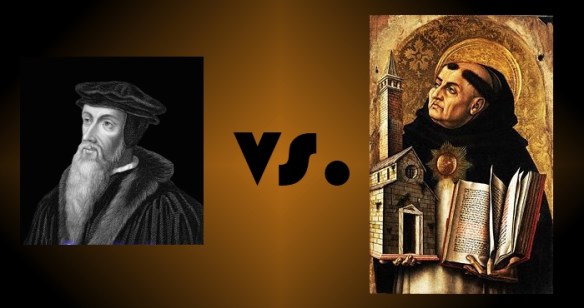
Aquinas and Calvinism
I once remember hearing that not only was the predestination of John Calvin not unique, it wasn’t even controversial among the deeper thinkers in Christian history. In fact, no less than Thomas Aquinas (1224-1274) could said to be something of a “5 Point Calvinist!”
The idea that Aquinas had a clear and strong view of predestination should be beyond dispute. No only does Aquinas’ masterpiece, Summa Theologica, contain several pertinent sections related to predestination, but Robert Mulligan translates several other relevant sections from his writings in Thomas Aquinas: Providence and Predestination (Chicago: Henry Regnery, 1953). He can say things like, “Clearly predestination is like the plan, existing in God’s mind, for the ordering of some persons to salvation. The carrying out of this is passively as it were in the persons predestined, though actively in God. When considered executively in this way, predestination is spoken of as a ‘calling’ and a ‘glorifying’, thus St. Paul says, ‘Whom he predestinated, them also he called and glorified.'” (Mulligan, 164).
But can Aquinas account as a 5 Point Calvinist? I rooted around for some quotes, and all of the following come from the Summa unless otherwise noted. Any emphasis is added by myself.
Total Depravity
“I answer that: Man’s nature may be looked at in two ways: first, in its integrity, as it was in our first parent before sin; secondly, as it is corrupted in us after the sin of our first parent. Now in both states human nature needs the help of God as First Mover, to do or wish any good whatsoever, as stated above. Continue reading
Resources for Preaching on Galatians
For the weeks leading up to December 25 (what the un-RPW world calls otherwise known as “Christmas” & “Advent”), we’re taking a 30,000 ft aerial flyover of the book of Galatians. Thinking especially that God sent His Son “in the fullness of time,” we’ll be using Galatians as a foil for considering Christ – and His benefits – that have come to us in these last days where we have the fullness of Christ. Topics like justification, adoption, freedom, covenant, the apostolic ministry, sanctification, and the Gospel will be addressed. And with the short window we’re giving ourselves, along with the 30k ft approach, that means I have to be pretty concise; so no, I won’t be doing any extended reflections in this series on “what are the στοιχεῖα τοῦ κόσμου?”
Here are some of the resources that I’ve found helpful for thinking about Galatians:
F.F. Bruce’s commentary in the NIGTC series. I love this series (usually) and I enjoy Bruce. Continue reading
Reformation Day Lesson 2011: Standing Firm in the Faith to the End
Things have been pretty busy for myself, my church, and my family lately, so I doubt I’ll put up the whole text from our Reformation Day festivities at church, but what follows is the outline for Reformation Day conference that encouraged us to stand firm in the faith. May we all stand firm in the power He provides. “Our hope is in no other save in Thee / Our faith is built upon Thy promise free / Oh grant to us such stronger help and sure / That we can boldly conquer and endure.”
Standing Firm in the Faith
I. Introduction
A. How Scripture Exhorts Us to Stand Firm
1. And Moses said to the people, “Fear not, stand firm, and see the salvation of the LORD, which he will work for you today. For the Egyptians whom you see today, you shall never see again. (Exodus 14:13)
2. For freedom Christ has set us free; stand firm therefore, and do not submit again to a yoke of slavery. (Galatians 5:1)
3. Therefore, my brothers, whom I love and long for, my joy and crown, stand firm thus in the Lord, my beloved. (Philippians 4:1)
4. But we ought always to give thanks to God for you, brothers beloved by the Lord, because God chose you as the first fruits1 to be saved, through sanctification by the Spirit and belief in the truth. To this he called you through our gospel, so that you may obtain the glory of our Lord Jesus Christ. So then, brothers, stand firm and hold to the traditions that you were taught by us, either by our spoken word or by our letter. Now may our Lord Jesus Christ himself, and God our Father, who loved us and gave us eternal comfort and good hope through grace, comfort your hearts and establish them in every good work and word. (2 Thessalonians 2:13-17)
5. I have written briefly to you, exhorting and declaring that this is the true grace of God. Stand firm in it. (1 Peter 5:12)
B. How the Reformation Exhorts Us to Stand Firm
II. The Uniqueness of the Protestant Reformation
A. The General Consensus on the Need for Reforming the Church
B. Previous Reformation Attempts
C. What Was Unique About the Protestant Reformation
- Creeds vs Deeds
- Reformation vs Revolution
- New Technology – the Gutenberg Press
Reformed Exclusivism
How do the various claims to truth of world religions relate to one another? Further, how should Christians think of salvation for those who have never heard? The traditional distinction to answer this question breaks into three categories:
- Exclusivism: Jesus is the only Savior of the world, and one must believe God’s special revelation culminating in the gospel of Christ to be saved.
- Inclusivism: Jesus is the only Savior of the world, but one does not have to believe the gospel to be saved.
- Pluralism: All paths are valid and lead to God.
Andy Naselli points to Christopher W. Morgan’s “Inclusivisms and Exclusivisms” in Faith Comes by Hearing: A Response to Inclusivism (WTS books). Morgan drills down into these categories, and notes that while most theologians still operate within these traditional sectors as a framework, in reality there are nine discernible categories:
- Church exclusivism: No, outside the church there is no salvation.
- Gospel exclusivism: No, they must hear the gospel and trust Christ to be saved.
- Special revelation exclusivism: No, they must hear the gospel and trust Christ to be saved, unless God chooses to send them special revelation in an extraordinary way—by a dream, vision, miracle, or angelic message.
- Agnosticism: We cannot know.*
Calvin’s Ecclesiastical Ordinances
The Genevan Book of Order
The Form of Prayers and Ministration of the Sacraments, etc.
Used in the English Congregation at Geneva (1556)
Of Ministers and Their Election
What Things are Chiefly Required in the Pastors and Ministers
Used in the English Congregation at Geneva (1556)
What Things are Chiefly Required in the Pastors and Ministers
First, let the church diligently consider that the minister which is to be chosen[a] be not found culpable of any such faults which St. Paul reprehends in a man of that vocation,[b] but contrariwise endowed with such virtues, that he may be able to undertake his charge, and diligently execute the same. Secondly, that he distribute faithfully the word of God, and minister the sacraments sincerely,[c] ever careful not only to teach his flock publicly, but also privately to admonish them;[d] remembering always, that if any thing perish through his default, the Lord will require it at his hands.[e]
a. Acts 1:21-23; 13:2-3; 14:23 Continue reading
Resources on Regeneration
I’m hoping to do some extended thinking (and preaching?!) on regeneration in the next few weeks/months, and I was thinking I should line up a list for reading and meditating on this important doctrine. Unfortunately, it can be a little difficult to find extended discourses on the topic of regeneration. I attribute that to a variety of factors:
-
- In the history of doctrine, regeneration has been something of a moving target, especially for Calvin’s successors, where regeneration can mean anything from conversion, repentance, sanctification, or the newer clarification of speaking exclusively of the (initiation of) spiritual life.
Calvin: Benefits from Justification for Children
Calvin wanted Christ’s little lambs to know the doctrine of justification by faith alone, and he wanted them to know that justification also provided:
- Sanctification – as distinguished from, but – inseparable with it
Master.But can this [imputed] righteousness be separated from good works, so that he who has it may be void of them?
Scholar. That cannot be. For when by faith we receive Christ as he is offered to us, he not only promises us deliverance from death and reconciliation with God [i.e., justification], but also the gift of the Holy Spirit, by which we are regenerated to newness of life [i.e., sanctification]; these things must necessarily be conjoined so as not to divide Christ from himself.
- Assurance of salvation
M. What advantage accrues to us from this forgiveness [which is, of course, included in justification]? Continue reading