Liberal, ahistorical Scholastics?

Leithart comments:

In a Mars Hill Audio interview, Ellen Charry observes that the Protestant theologians of the seventeenth century, even before the Enlightenment, had a tendency to detach truth from historical reference. The truth of theology was seen in the coherence of the system of truth found in Scripture, rather than a truth of reference to historical events.

Charry’s comment was a passing one, no doubt a drastic oversimplification. Protestant scholastics, after all, defended the historical reliability of Scripture as well as its systematic coherence. But, the comment seems worthy of investigation, since it might provide a historical link between Protestant scholasticism and the development of liberal theology.

Maybe there is some truth to this claim, especially since “the Protestant theologians of the seventeenth century” (no reference to confessional position, orthodoxy, etc.) is a pretty wide generalization. I didn’t listen to the interview, and like Leithart noted, it was a passing comment.

That said, there are important nuances to this idea. If by “Protestant theologians of the seventeenth century” one is referring to Reformed Scholastics like Cocceius, Voetius, Brakel, Turretin, Owen, or Witsius, then qualifications should be noted. These qualifications follow in patterns that we, and Charry?, may not quickly set upon. First, the scholastics (and Protestant scholastic era) were some of the best with historically-referent theology, and secondly, despite their connections with history, some of these theologians were quickest into the liberal slide. Continue reading


St. Bartholomew’s Day Massacre

On August 24, 1572, one of the more tragic events occurred in the wars of religion throughout France. Especially within Paris, France, tensions between the Papist Parisians (the majority) and the French nobility and laity that held to the Reformed faith – referred to as Huguenots – were at a premium. After a failed assassination attempt on Admiral de Coligny, a noted Reformed Christian, on August 22, the animosity reached an all time high.

The Huguenot Cross

Catherine de Medici was the queen mother, and by urging her son Charles IX that Reformed Huguenots were a political threat to the stability of Paris and France, de Coligny was assassinated just before dawn on August 24. Following his death, rioting broke out in Paris, which then swept through the country, where neighbor turned on neighbor, and the Catholic majority looted and murdered their Reformed countrymen in a tragic event for the Reformed faith. Continue reading

Dear Pastor: Straight Talk on Hell

Dear Pastor,
This article was sent to me from a friend who does not believe in hell. He believes a loving father would never send His child to hell is what . I know he sent this to me because he knows I do believe in hell. How do I respond in a clear fashion?
Thanks,
[redacted]

You asked about the article that was sent to you, written by an author named Oliver Thomas. In the article, he makes some claims in the article that I want to point out, and then I’ll give you a few thoughts on how you should speak to your friend about this, as well as some resources that are available to help you. But first, let’s examine some of the author’s claims:

Hell in the Old Testament
1. Does the Old Testament teach everlasting punishment after death? The author of the article says, “Nowhere in the Hebrew Bible (Christian Old Testament) is the abode of the dead described as a place of eternal punishment.” The article is quite correct, in that the most common description of what awaited people after death was known as sheol, a shadowy, uncertain place. Both godly, righteous people and the wicked ended up in sheol. But sheol has a few different meanings in the Old Testament, and the author is ignoring parts of what the Bible says. Continue reading

Opening Salvo on the Blood Prohibition

You must not eat meat that has its blood still in it. Genesis 9:4

Background

One of my preaching practicums had us select passages to preach on a doctrinal or ethical subject, and the passages were up for grabs among the students. Through my own choice (thinking I’d “challenge” myself) and what my peers had narrowed in options, I ended up with Leviticus 17. Preaching in the Old Testament? Sure. Preaching from Leviticus? Definitely more challenging. But I had not ever really grappled with the “blood ban” before, and I am so grateful for the opportunity. I hope to do a series of looking at different aspects of the Blood Prohibition.

Why the Blood Prohibition?

The “blood ban” is actually a fantastic opportunity for the student of Scripture to stretch themselves in the whole discipline of theology. Following the likes of Geerhardus Vos, true theology is a multi-discipline process, and looking at the Blood Prohibition allows one to utilize all of their skills. First, there is the exegetical component. Continue reading

Bumper Sticker Theology

“There was; when He was not” – Arius
“As soon as a coin in the coffer rings / the soul from purgatory springs.” – John Tetzel
semper eadem” (always the same) – Romish Counter-Reformation
“I can write the Gospel on a dime.” Dwight L. Moody
“Once saved always saved.” (large swaths of) American Evangelicalism
“Let go and let God.” Am. Evangelicalism
et cetera ad nauseum

Clearly, there have been some less than helpful slogans running through the corridors of church history. However, aren’t the solas more or less slogans? Reformed churchmen have utilized pithy sayings as well. So how should we think about sloganeering? Useful if it has the right theology (pragmatic)? Fight fire with fire? Or is there another means for addressing this phenomenon?

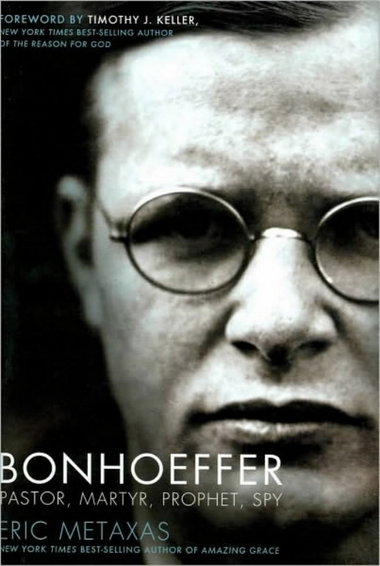
Bonhoeffer on Cheap Grace

The following are large quotes and snippets from Bonhoeffer’s Cost of Discipleship, pages 45 – 49. A few thoughts afterward.

“Cheap grace is the deadly enemy of our Church. We are fighting today for costly grace… Cheap grace means grace as a doctrine, a principle, a system. It means forgiveness of sins proclaimed as a general truth, the love of God taught as the Christian ‘conception’ of God. An intellectual assent to that idea is held to be of itself sufficient to secure remission of sins…. In such a Church the world finds a cheap covering for its sins; no contrition is required, still less any real desire to be delivered from sin. Cheap grace therefore amounts to a denial of the living Word of God, in fact, a denial of the Incarnation of the Word of God.

“Cheap grace means the justification of sin without the justification of the sinner. Grace alone does everything they say, and so everything can remain as it was before. ‘All for sin could not atone.’ Well, then, let the Christian live like the rest of the world, let him model himself on the world’s standards in every sphere of life, and not presumptuously aspire to live a different life under grace from his old life under sin…. Continue reading

The Athenian Creed

What is the Athenian Creed? Perhaps it is one of the post-Refomration creeds newly republished thanks to Dennison’s or Van Dixhoorn’s work? Or perhaps it is merely an example of Old Side Presbyterianism skewering unbelief and modernism within the Church? If you’re leaning toward the latter, you’d be spot on.

Recently, over at WHI, Mike Horton highlighted the satire that John Witherspoon used to skewer the modernists and Moderates in the Kirk of Scotland. His Ecclesiastical Characteristics, divided into certain “Maxims,” were a hot iron toward his liberal contemporaries.

One such Maxim was his “creed,” a lampooning article of what he considered to be the reigning ideology of the day. Continue reading

Resources on Regeneration

I’m hoping to do some extended thinking (and preaching?!) on regeneration in the next few weeks/months, and I was thinking I should line up a list for reading and meditating on this important doctrine. Unfortunately, it can be a little difficult to find extended discourses on the topic of regeneration. I attribute that to a variety of factors:

    • In the history of doctrine, regeneration has been something of a moving target, especially for Calvin’s successors, where regeneration can mean anything from conversion, repentance, sanctification, or the newer clarification of speaking exclusively of the (initiation of) spiritual life.

Continue reading

Calvin: Benefits from Justification for Children

Calvin wanted Christ’s little lambs to know the doctrine of justification by faith alone, and he wanted them to know that justification also provided:

  1. Sanctification – as distinguished from, but – inseparable with it

    Master.But can this [imputed] righteousness be separated from good works, so that he who has it may be void of them?

    Scholar. That cannot be. For when by faith we receive Christ as he is offered to us, he not only promises us deliverance from death and reconciliation with God [i.e., justification], but also the gift of the Holy Spirit, by which we are regenerated to newness of life [i.e., sanctification]; these things must necessarily be conjoined so as not to divide Christ from himself.

  2. Assurance of salvation

    M. What advantage accrues to us from this forgiveness [which is, of course, included in justification]? Continue reading

Harold Camping?

Here are some resources for thinking about Harold Camping’s “prediction” of the rapture on May 21, 2011, and the end of the world in October, 2011.

Godfrey – “The problem with Harold Camping is that he’s lost the Gospel. He’s lost Christ.”
Mohler: The End Is Near? The False Teaching of Harold Camping
Michael S. Rosenwald, “This Time, It’s for Real, Believers Say: Doomsday Coming This Month,” The Washington Post, Thursday, May 5, 2011.
Sproul Jr: Not a False Prophet, Just a Bad Exegete
A Conversation with Harold Camping, Prophesier of Judgment Day,” New York Magazine, Wednesday, May 11, 2011.
Godfrey – Harold Camping and the End of the World – WSCal Valiant for Truth series
Riddlebarger – Old Issues with Camping

Needless to say, I’m not going to stop preparing my sermon for Sunday, May 22. I’ll try to get a comment here on Monday, just to check in!