Simeon’s Account of His Conversion

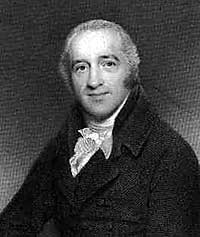
I hope you share my feeling of being encouraged to read of how God’s arresting grace breaks in on peoples’ souls. Charles Simeon (1759 – 1836) was an Anglican vicar and professor who beautifully recorded his own experience of God’s rescue in his life. Going from a life of outward religion and lavish extravagance to a vital trust in Christ and self-denial, Simeon shared the experience of change in his own life.
The following quote is taken from John Piper’s The Roots of Endurance (Crossway, 2002) p. 82.

In Passion Week, as I was reading Bishop Wilson on the Lord’s Supper, I met with an expression to this effect – “That the Jews knew what they did, when they transferred their sin to the head of their offering.” The thought came into my mind, What, may I transfer all my guilt to another? Has God provided an Offering for me, that I may lay my sins on His head? Then, God willing, I will not bear them on my own soul one moment longer. Accordingly I sought to lay my sins upon the sacred head of Jesus; and on the Wednesday began to have a hope of mercy; on the Thursday that hope increased; on the Friday and Saturday it became more strong; and on the Sunday morning, Easter-day, April 4, I awoke early with those words upon my heart and lips, “Jesus Christ is risen to-day! Hallelujah! Hallelujah!” From that hour peace flowed in rich abundance into my soul; and at the Lord’s Table in our Chapel I had the sweetest access to God through my blessed Savior.

Amen and amen. May every tribe, tongue and nation come to know that peace and access through Christ alone.

Apologetics from Colbert

Can you learn to do Van Tillian apologetics from watching The Colbert Report?(HT: Reformed Forum)

SC got a lot of great one liners in, including a terrific set up for his last line. Though the entire show is on the chin, it was also a profound demonstration that something ≠ nothing. Further, the way Krauss was willing to speak in hushed/awed tones of “what we now know from quantum mechanics,” it is easy to see everyone worships something (and has presuppositions to boot).

Who was Van Til?

Here’s an old post from my old blog on Van Til’s ideas, with several quotes and pictured charts (though apologies in that it is hard to read):
A Van Til in the Hand is Worth A Kant and Hume in the Bush

Is Your VBS Christ-Centered and Gospel-Powered?

Dear Zion,

We are so excited to get kids pumped up for Jesus in our VBS program this summer, but we will not be teaching the Babylon lesson curriculum exactly as it is written. Even though the Babylon lessons teach a lot of good things – like trusting God when we’re scared, and the importance of gratitude and prayer – it does not focus on Jesus[*]. We want our kids at Zion to not only live a godly life, but we want them to do so because they love Jesus so much! In Luke 24:27, 44 we learn that all of the Bible, even Old Testament books like Daniel, were written to teach us about Jesus, and that He is the center of the story, not us. Sometimes, our message to kids is “improve your life by daring to be like Daniel,” but we forget that the Bible is about what Jesus wants to do to our lives. So this year, we want to take our VBS further.
Maybe some examples would help: Continue reading

Tree of Life: Two Ways

The nuns taught us there were two ways through life—the way of nature and the way of grace. You have to choose which one you’ll follow… Grace doesn’t try to please itself. Accepts being slighted, forgotten, disliked. Accepts insults and injuries… Nature only wants to please itself. Get others to please it too. Likes to lord it over them. To have its own way. It finds reasons to be unhappy when all the world is shining around it. And love is smiling through all things… They taught us that no one who loves the way of grace ever comes to a bad end.

I will be true to you, whatever comes.

Select Works of Samuel Miller (1769 – 1850)

Recently, I came across Miller’s Thoughts on Public Prayer, and was greatly helped. I knew Miller to be a staunch Old School Presbyterian, and so I wondered what else of his I could find online for free. Turns out, pretty much everything he wrote is at Google Books. Help yourself!

UPDATE: The original post was by no means exhaustive, but thankfully the PCA Historical Center already had compiled the Samuel Miller Collection. While there aren’t many links at the Collection, there is a complete bibliography listed. I was reminded of this by The Confessional Presbyterian which points this resource out.

A Brief Retrospect of the Eighteenth Century (1803, 1805)

A Sermon on Lamentations 2:1, 13 (1812)

An Able and Faithful Ministry (1812)

Memoir of the Reverend John Rogers (1813)

Letters on Unitarianism (1821)

Letter on Christmas Observance (1825) Continue reading

Review: From the Resurrection to His Return

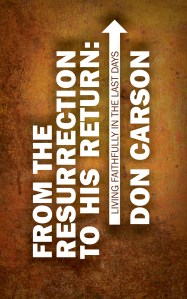
D.A. Carson From the Resurrection to His Return: Living Faithfully in the Last Days (Christian Focus, 2010)
Kindle publication at Amazon
Paperback at WTS Books

(this review looks at the unpaginated eBook version)

Christian Focus has published another brief but useful classic from Dr. Carson on II Timothy. The subject of “end times,” or even more dauntingly – eschatology, brings confusion for many, but Carson treats the heart of the matter: living faithfully for Christ in these last days. More information on the book can be found at The Gospel Coalition (though I myself did not have access to it at the time of the review). Carson’s book is an accessible guide for Christians unto faithful living packed with simple but gripping lessons, that is recommended for anyone.

Overview

Chapter 1, “Living in the Last Days,” is a smooth, concise, running commentary of prose on II Timothy 3:1 – 9. The entire text of 2 Timothy 3 – 4:6 appears just before, but without a note of explanation. Nowhere are you alerted to what this book is: a commentary? devotionals? summary? Despite a disorienting beginning, Carson’s insights into the text are engaging and helpful. Unlike the rocky beginning, the remaining chapters easily flow into one another. Continue reading

A Concise Argument for Definite Atonement

The following is a summary of the classic argument put forward by John Owen in The Death of Death in the Death of Christ

_____________________
The Father imposed His wrath due unto, and the Son underwent punishment for, either:

  1. All the sins of all men.
  2. All the sins of some men, or
  3. Some of the sins of all men.

In which case it may be said:

  1. That if the last be true, all men have some sins to answer for, and so, none are saved.
  2. That if the second be true, then Christ, in their stead suffered for all the sins of all the elect in the whole world, and this is the truth.
  3. But if the first be the case, why are not all men free from the punishment due unto their sins?

You answer, “Because of unbelief.”

I ask, Is this unbelief a sin, or is it not? If it be, then Christ suffered the punishment due unto it, or He did not. If He did, why must that hinder them more than their other sins for which He died? If He did not, He did not die for all their sins!”

Sovereignty, Providence, and Good Works in 2012

Dear Zion,

There’s no use denying it any longer: 2012 is here! As we enter into this “New Year,” all sorts of new experiences come with it: new hopes and new fears for what the new year may bring; new possibilities – as well as the feelings of regret and loss that can come as time marches on. With all of the unknowns in the future, feelings of anxiety, fear, curiosity, or hope can settle into all of our hearts. But no matter what 2012 brings with it for good or for bad, Christians have a rock-solid confidence in two important doctrines: God’s sovereignty over 2012, and God’s providence for 2012.

The Sovereignty of God over 2012
No matter what the new year brings, we can be sure of this: God is in control of 2012. All times are in His hand, and since He is the Alpha and the Omega, the First and the Last (Revelation 1:8), we know that He makes the ends known from the beginning (Isaiah 46:10). Every day that we live in 2012 has already been written in His book (Psalm 139:16), and nothing that happens to us can happen apart from His will. Life and death, health and sickness are in His hands (Deuteronomy 32:39). Neither a sparrow (Matthew 10:29 – 31) nor a hair from your head (Luke 21:16 – 18) can fall apart from God’s will. So for those who love God and are called according to His purpose, the future of the new year doesn’t need to be a scary thing, because He has promised that all things will work together for our good (Romans 8:28). As we make our plans for 2012, we should recognize God’s absolute power and control over all the decisions we make, and ultimately entrust ourselves and our plans to Him (James 4:13 – 17).

The Providence of God for 2012 Continue reading

449 Years of Our “Only Comfort in Life and Death”

A Wordle of the Catechism

On January 19, 1563 the first edition of the Heidelberg Catechism was sent to the printers by Elector Frederick III. The catechism, penned by Zacharius Ursinus and Caspar Olevianus, has served as a masterpiece of theological and pastoral wisdom from God’s Word for Reformed Christians for centuries.

Q. 60 How are you righteous before God?

A. Only by a true faith in Jesus Christ; so that – though my conscience daily accuses me, that I have greatly transgressed all the commandments of God, and kept none of them, and am still inclined to all evil – nevertheless, God, without any merit of mine, but only by His mere grace, grants and imputes to me: the perfect satisfaction, righteousness and holiness of Christ; even so, as if I never had had, nor committed any sin: yea, as if I had fully accomplished all that obedience which Christ has accomplished for me; inasmuch as I embrace such benefits with a believing heart.

What’s so great about the Heidelberg Catechism? Here are ten characteristics for you: Continue reading

Reforming lectio divina

Spirituality is still a huge topic with evangelical Christians, and increasingly practices such as lectio divina are encouraged even for Reformed Christians. But is this practice helpful? And how can it be used by Christians in the Reformed tradition?

Lectio divina (or, divine reading) as described by Kenneth Boa in his book Conformed to His Image, (Zondervan, 2001), 96-97.

The ancient art of lectio divina, or sacred reading, was introduced to the West by the Eastern desert father John Cassian early in the fifth century.

It consists of four elements.

  1. Lectio (reading). Select a very short text and ingest it by reading it several times. Normally, one chooses a verse or a brief passage from the chapters read from the Old and New Testaments in morning Bible reading.
  2. Meditatio (meditation). Take a few minutes to reflect on the words and phrases in the text you have read. Ponder the passage by asking questions and using your imagination.
  3. Oratio (prayer). Having internalized the passage, offer it back to God in the form of personalized prayer.
  4. Contemplatio (contemplation). For the most of us, this will be the most difficult part, since it consists of silence and yieldedness in the presence of God. Contemplation is the fruit of the dialogue of the first three elements; it is the communion that is born out of our reception of divine truth in our hearts.

I think there is much to appreciate about lectio divina, especially its Agassiz-like focus on a text. Further, that Scripture ought to bid us pray and that our prayers ought to be filled with Scripture is an axiom of this discipline, so to the extent that the lectio divina encourages this is a boon. I would even go so far as to say – due to the importance of prayer in the Christian life – that anything that encourages prayer in the life of believers is a good thing. But having said all of this, let me turn to a few concerns. Continue reading