
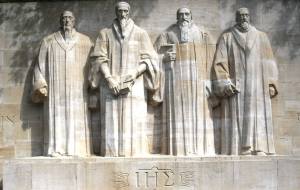
Reformation Day Lesson 2011: Standing Firm in the Faith to the End

Things have been pretty busy for myself, my church, and my family lately, so I doubt I’ll put up the whole text from our Reformation Day festivities at church, but what follows is the outline for Reformation Day conference that encouraged us to stand firm in the faith. May we all stand firm in the power He provides. “Our hope is in no other save in Thee / Our faith is built upon Thy promise free / Oh grant to us such stronger help and sure / That we can boldly conquer and endure.”

Standing Firm in the Faith
I. Introduction
A. How Scripture Exhorts Us to Stand Firm
1. And Moses said to the people, “Fear not, stand firm, and see the salvation of the LORD, which he will work for you today. For the Egyptians whom you see today, you shall never see again. (Exodus 14:13)
2. For freedom Christ has set us free; stand firm therefore, and do not submit again to a yoke of slavery. (Galatians 5:1)
3. Therefore, my brothers, whom I love and long for, my joy and crown, stand firm thus in the Lord, my beloved. (Philippians 4:1)
4. But we ought always to give thanks to God for you, brothers beloved by the Lord, because God chose you as the first fruits1 to be saved, through sanctification by the Spirit and belief in the truth. To this he called you through our gospel, so that you may obtain the glory of our Lord Jesus Christ. So then, brothers, stand firm and hold to the traditions that you were taught by us, either by our spoken word or by our letter. Now may our Lord Jesus Christ himself, and God our Father, who loved us and gave us eternal comfort and good hope through grace, comfort your hearts and establish them in every good work and word. (2 Thessalonians 2:13-17)
5. I have written briefly to you, exhorting and declaring that this is the true grace of God. Stand firm in it. (1 Peter 5:12)

B. How the Reformation Exhorts Us to Stand Firm

II. The Uniqueness of the Protestant Reformation
A. The General Consensus on the Need for Reforming the Church
B. Previous Reformation Attempts
C. What Was Unique About the Protestant Reformation

  1. Creeds vs Deeds
  2. Reformation vs Revolution
  3. New Technology – the Gutenberg Press
  4. Continue reading

Luther and the Jewish Question

Since yesterday was Reformation Sunday, our talks among the congregants eventually drifted to the question of charges of antisemitism toward Martin Luther. As a Protestant, Reformational Christian, I deeply admire Luther for what he did and accomplished, but never venerate the man nor overlook his (many) flaws and faults. His writings against the Jews are one of his flaws that we justly decry and lament. Like Zwingli’s maiden or Calvin’s handling of Servetus, these are historical instances that need to be placed in their context, condemned for what was sinful, and examples to learn from.

The first thing to remember when thinking about this subject is how Luther’s contemporaries thought about the Jewish question. In the 1530’s and 1540’s, the whole question of how to relate to Jewish people and the Judaic belief system was a highly charged and volatile issue. Writers from both the Catholic and Protestant perspectives both defended and attached Jews for everything from heresy, usury, treason and anarchy, and the ritualistic murder of children. Further, in a point that is often overlooked, there is a difference in Christians writing “anti-semite” material vs writing “anti-Judaic” material. The first attacks an ethnic people group, the second attacks a religion and belief system at odds with the claims of Christianity. The first is decidedly anti-Christian, the second is decidedly necessary for Christian apologists (see: the entire book of Galatians). Continue reading

Women’s Fellowship Annual Address 2011 Part 2

Last time, we looked at how Christ’s ministry is the foundation for the Church’s ministry. You can read part 1 here. We continue with how, but considering Christ’s emphasis for the church, how that may shape our own Women’s ministry.

So then what might Christ’s ministry say to our Women’s Fellowship here at Zion? Broadly, it first gives us some emphases to keep in mind in all our ministry:

Women’s Ministry Themes
Attractional vs. Missional
Attractional approaches to ministry are those which basically take the “if we build it, they will come” direction. These churches are typically known for their varied resources often including rock walls, coffee shops, gyms, sports leagues, etc. The idea that drives this approach is that if you can just get the people in the doors, you can keep them there.

We prefer to view things not from an attractional, but a missional perspective. Instead of ministering on the basis of people coming to us, our approach is to take the ministry to the people. Like the Son of God condescending to leave His heavenly home and dwell among those whom He loved, we want to be known for our willingness to take the gospel from within the walls of our building to affect the lives of those we come into contact.

Width vs. Depth
In polling various churches, the vast majority cite numeric growth as their driving evidence of success. Success is measured by quantifiable numbers of weekly attendance, small group attendance, Sunday school attendance, etc. Achievement is determined by the number of people with whom the message is shared. We want our primary purpose of the local church to be making disciples. Not mere attendees or even converts, but disciples – mature followers of Jesus Christ. In the end, the “Father is glorified by this, that you bear much fruit and so prove to be [Christ’s] disciples” (John 15:8). As we go deeper in Christ, we will pull others along with us.

Marketing vs. Gospel
Some churches emphasize a certain “draw.” Perhaps they are the church with good music, or a great drama team or a really excellent children’s ministry. Like the attractional approach, the hope is to market the church to bring people in. The problem that we see with this approach is that it is generally true that “what you win them with is what you keep them with.” If you win people with lights and smoke, then next year you need more lights and more smoke. You are always forced to better your resources and marketing of those resources to distinguish yourself. The challenge is that the culture is always changing and when you market a specific segment or ministry, then you inevitably teach that your church is not for everyone.

At Zion we hope to win people by the gospel of Jesus Christ. If we can do this, then all we have to do to keep them is continue to preach the gospel — what we should be doing anyway. We hope to accomplish this through challenging our people to have a missional perspective as they live a gospel-centered life. So, the church will experience growth because of mission rather than marketing.

Entitlement vs. Sacrifice
A deep and pervasive sense of entitlement exists in much of the evangelical community. Those who have such an attitude, though they might not articulate it, assume that the church exists merely to
meet one’s own felt needs. Therefore, the church that caters to such an ideology is forced to create thousands of different programs to meet those ever-changing desires.

The Bible teaches not that the church exists to meet your needs, but rather that you exist to meet the needs of others. A heart of humility does not say “meet my needs,” but instead “do not cater to me. I am here to serve.” In the end, the greatest need, felt or not, is for the gospel. If we spend our time meeting peripheral issues, all we have done is dealt with symptoms without addressing the disease. Certainly we recognize the legitimacy of needs and are here to serve those in need, but an attitude of entitlement and true service are at odds.[2] Continue reading

Pascal’s Pensees and Pauline Perspective

Blaise Pascal (1623 – 62) wrote his justly famous Pensees, and perhaps one of the more well known passages is his “Wager” or “Gambit.” In part III note 233, it goes as such:

“God is, or He is not.” But to which side shall we incline? Reason can decide nothing here. There is an infinite chaos which separated us. A game is being played at the extremity of this infinite distance where heads or tails will turn up… Which will you choose then? Let us see. Since you must choose, let us see which interests you least. You have two things to lose, the true and the good; and two things to stake, your reason and your will, your knowledge and your happiness; and your nature has two things to shun, error and misery. Your reason is no more shocked in choosing one rather than the other, since you must of necessity choose… But your happiness? Let us weigh the gain and the loss in wagering that God is… If you gain, you gain all; if you lose, you lose nothing. Wager, then, without hesitation that He is.

The Wager is often expressed in the following table:

                                  Does God exist?
Yes No
Do I believe in God? Yes Eternal blessing is gained. No reward
No Eternal blessing is lost. No loss

Now here is my question. I won’t try to answer it here (perhaps in a future post). Is Pascal’s Wager above consistent with Paul’s argument below? Continue reading

Update: New Reformed Church in Twin Cities

Getting biblically solid, confessionally Reformed churches in the Midwest is not easy, and St. Paul & Minneapolis MN prove no exception. So it is exciting to see that fellow WSCal grad Rev. Ryan Kron is starting a church plant in the Minneapolis and Eden Prairie area. So if you’re in the southwest Metro area, give Emmaus Road Reformed Fellowship a look.

Update: “Fellowship” no more! Emmaus Road Reformed Church is officially up and running online, and you can join them for corporate worship this Sunday at:
Eden Lake Elementary School
12000 Anderson Lakes Parkway
Eden Prairie, MN 55347
(Google maps & directions)

Emmaus Road pastor Rev. Kron says: Continue reading

Update on Pastor Youcef

“Blessed are you when others revile you and persecute you and utter all kinds of evil against you falsely on my account. Rejoice and be glad, for your reward is great in heaven, for so they persecuted the prophets who were before you.” Matthew 5:11-12

Iranian Pastor Youcef Nadarkhani was arrested and sentenced to execution by hanging for refusing to recant his Christian beliefs and apostatizing from Islam. Read our first post here. More and more has surfaced about the persecuted pastor, and you can read more about his plight and legal case (see Christianity Today and ACLJ).
Pastor Youcef wrote the following letter last summer. (HT: WHI)

Dear brothers and sisters, Salam

In the Name of our Lord Jesus Christ, I am continuously seeking grace and mercy to you, that you remember me and those who are bearing efforts for his name in your prayers. Your loyalty to God is the cause of my strength and encouragement. For I know well that you will be rewarded; as it’s stated: blessed is the one who has faith, for what has been said to him by God, will be carried out. As we believe, heaven and earth will fade but his word will still remain.

Dear beloved ones, I would like to take this opportunity to remind you of a few verses, although you might know them, So that in everything, you give more effort than the past, both to prove your election, and for the sake of Gospel that is to be preached to the entire world as well. Continue reading

Dear Pastor: Do New Covenant Believers Tithe?

Dear Pastor,
I have given in the past, but now I have questions about tithing. I would like to know more about tithing and was hoping that at some point you could visit with me about it….or address it from the pulpit.

Thanks,
[redacted]

R.C. Sproul marvels:

Recently, I read an article that gave an astonishing statistic that I find difficult to believe is accurate. It declared that of all of the people in America who identify themselves as evangelical Christians, only four percent of them return a tithe to God. If that statistic is accurate, it means that ninety-six percent of professing evangelical Christians regularly, systematically, habitually, and impenitently rob God of what belongs to Him. It also means that ninety-six percent of us are for this reason exposing ourselves to a divine curse upon our lives. Whether this percentage is accurate, one thing is certain — it is clear that the overwhelming majority of professing evangelical Christians do not tithe.

What is the tithe, and does it still apply today?

The Bible has many instructions regarding the tithe. The tithe is a concept of 1 out of 10. Sproul again: “We are required to give ten percent of our gross annual income or gain. If a shepherd’s flock produced ten new lambs, the requirement was that one of those lambs be offered to God. This offering is from the top. It is not an offering that is given after other expenses are met or after other taxes have been paid.”

Generally, the tithe was to be given to the Lord’s servants, the Levites (Numbers 18:21ff). In the Old Testament, many alms for the poor were above and beyond the tithe (e.g. Exod. 23:10-11; Lev. 19:9-10; 25:35-37; Deut. 15:7-11; 24:12-15). The tithe had many purposes, including: to support the priesthood (Num. 18:21-32; Deut. 14:28-29); to honor God in sacrifice and feasts (Lev. 27:31; Num. 18:26-28; Deut. 14:22-26); and to feed the aliens, widows and orphans (Deut. 14:28-29; 26:12).

Some people argue that the tithe is no longer applicable in the New Testament era, as this was only for the Old Covenant era. Continue reading

Authorship of Job

I’m preparing to do a class at church on what we believe about the Bible, and I hope to address some of the issues Christians face today regarding inerrancy, infallibility, and the role God’s Word should have in our daily life. There are few better on the nature of Scripture than John Owen.

Owen (1616 – 1683) broke new ground on the doctrine of the Holy Spirit in his Pneumatologia (1693). One distinction he made was between prophecy in general and the inspiration of Scripture to the prophets. “The writing of Scripture was another effect of the Holy Ghost, which had its beginning under the Old Testament. I reckon this as a distinct gift from prophecy in general, or rather, a distinct species or kind of prophecy…”

Owen notes:

Now this ministry was first committed unto Moses, who, besides the five books of the Law, probably also wrote the story of Job. Many prophets there were before him, but he was the fist who committed the will of God to writing after God himself, who wrote the law in tables of stone; which was the beginning and pattern of the Scriptures.

(All quotes from Owen in Works, III.143).

Hywel Jones notes that, prior to the modern period, most followed a reference in the Jewish Talmud to Moses’ authorship of Job (Baba Bathra, 14). However, this should be “balanced by the fact that the book was placed in the third section of the Hebrew Bible because of its acknowledged anonymity” (Jones, A Study Commentary on Job [Evangelical Press, 2007] 18).

A Hermeneutic of Suspicion

Proverbs 3:5 Do not lean on your own understanding.
Proverbs 3:7 Be not wise in your own eyes; fear the LORD, and turn away from evil.
Proverbs 28:26 Whoever trusts in his own mind is a fool, but he who walks in wisdom will be delivered.
Isaiah 5:21 Woe to those who are wise in their own eyes, and shrewd in their own sight!
Isaiah 41:10 …Your wisdom and your knowledge led you astray…
Isaiah 55:8 For my thoughts are not your thoughts, neither are your ways my ways, declares the LORD.
Isaiah 65:2 I spread out my hands all the day to a rebellious people, who walk in a way that is not good, following their own thoughts.
Jeremiah 17:9 The heart is deceitful above all things, and desperately wicked; who can understand it?

Women’s Fellowship Annual Address 2011

Women’s Ministry In Christ’s Strength for the Church

Thank you for allowing me to come and share with you this afternoon. As Paul reminds us in Romans 1, we are mutually blessed by each other, and as I’ve been so blessed and strengthened and encouraged by so many of you, I hope that what we look at today from God’s Word will be a blessing you and our Women’s Fellowship as well.

At our last meeting, it was suggested that I speak a bit about how Women’s Fellowship fits into the overall ministry of the church, its role, etc. As I prayerfully reflected on this concept, I thought it might be best for us to first remind ourselves about what Jesus’ ministry, how His ministry instructs the Church’s ministry, and then lastly how our Women’s Fellowship and you as women in our congregation might live and serve for His glory from these truths. When we do that, I think we see that Christ is really our strength and our life for empowering all of our ministry in His Church.

Jesus’ Ministry
Well let’s start then by first reminding ourselves about the distinctives of Jesus’ ministry for what He was sent to do by the Father. You know, I’m working with our 9th grade catechism students, and this year it just happens that all of them are girls, and their mentors are moms and women here at the church. So I’m the only guy in there! And there are times when I think I’m going to have to leave the class; too much estrogen! But one of the things these girls have been struck by time and time again as we’ve worked through the Gospel of Luke is how Jesus’s actions are so completely against what the world expects, but also so contrary to what “good,” religious people expect as well.

For example, Jesus’ puts the priority of His ministry on teaching and preaching rather than on miracles.

Luke 4:42-43 he departed and went into a desolate place. And the people sought him and came to him, and would have kept him from leaving them, but he said to them, “I must preach the good news of the kingdom of God to the other towns as well; for I was sent for this purpose.”

We can understand why the people were so desperate to keep Jesus around; the previous context shows Jesus performing miracles at every turn: healings, restoring health, and casting out demons. We would think that this is the good life, to be rid of the evils of living in a fallen world, but Jesus has his sights set on proclaiming the Good News. Continue reading