Leaving A Legacy: My Grandpa Dr. R. A. Lund

On Friday, my grandfather’s body will be placed in the ground. We do so because we believe we are planting a seed, and that the Lord Jesus Christ will be harvesting humanity and raising us to new life. I’ve been so blessed by my grandpa, and what follows is his obituary and funeral service order. The notice at the funeral home is here.
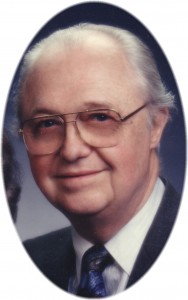
A celebration of life service for Dr. R. A. (Rod) Lund, 91, of Fairmont, MN, will be 11:00 a.m. Friday, December 9, at the Bethel Evangelical Free Church in Fairmont. Interment will be in Lakeside Cemetery in Fairmont with Military Honors by the Lee C. Prentice American Legion Post 36 and Martin County V.F.W. Post 1222. Visitation will be 4:00 to 7:00 P.M. on Thursday, December 8, at the Lakeview Funeral Home in Fairmont, MN, and will continue one hour prior to the service at the church. Dr. Lund passed away on Friday evening, December 2, 2011, at Mayo Clinic Health System in Fairmont. Rodney Alton Lund was born on March 19, 1920, in Opheim, Montana, the son of Charles and Maia (Bollum) Lund. He grew up in South Dakota, primarily Watertown, and then moved to Detroit Lakes, MN, in 1934, where he graduated from Detroit Lakes High School. In April of 1942, he graduated from the Minneapolis Chiropractic School. That same year he was inducted into the U.S. Army and was united in marriage to Mildred Melberg on June 5, 1942, in Little Rock, AR. Continue reading
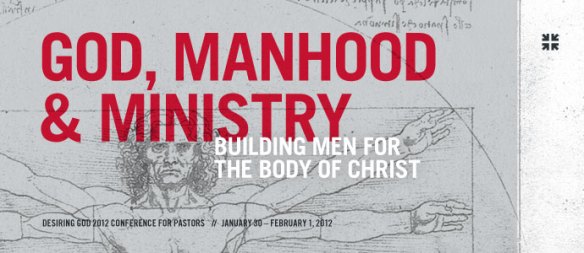
Pastors, Manhood & Ministry

The Desiring God 2012 Pastor’s Conference is entitled “God, Manhood & Ministry: Building Men for the Body of Christ.”

This year’s speakers are:
Doug Wilson
Darrin Patrick
Crawford Loritts
Ramez Atallah
John Piper

The conference, which takes place from January 30 – February 1, is on a topic that I’ve been thinking about a lot recently, so I’m very excited to hear some of these men’s thoughts. I’m secretly hoping Doug Wilson will get drug into a justification/covenant debate in the Q&A, that Piper’s bio on J.C. Ryle will be excellent, and that there will be some sort of “fire sale” in the bookstore just when I walk in (preferably on the NIGTC commentary series!).

Here’s a clip where Piper invites pastors – and elders! – to the conference: Continue reading

Calvin on Allah & Idolatry

I’ve looked at the claims of inclusivism, universalism, and exclusivism before, but sometimes the nature Allah confuses these issues. Do Christians and Muslims worship the same g/God? Does Islam and Christianity agree for at least one Person of the Trinity? Again, Calvin is helpful here:

Christ tells his disciples to believe in him, in order that they might have a distinct and complete belief in God, “Ye believe in God, believe also in me” (John 14:1). For although, properly speaking, faith rises from Christ to the Father, he intimates, that even when it leans on God, it gradually vanishes away, unless he himself interpose to give it solid strength. The majesty of God is too high to be scaled up to by mortals, who creep like worms on the earth. Therefore, the common saying that God is the object of faith (Lactantius, lib. 4 c. 16), requires to be received with some modification. When Christ is called the image of the invisible God (Col 1:15), the expression is not used without cause, but is designed to remind us that we can have no knowledge of our salvation, until we behold God in Christ …

What I wish to impress upon my readers in this way is, Continue reading

Aquinas and Calvinism

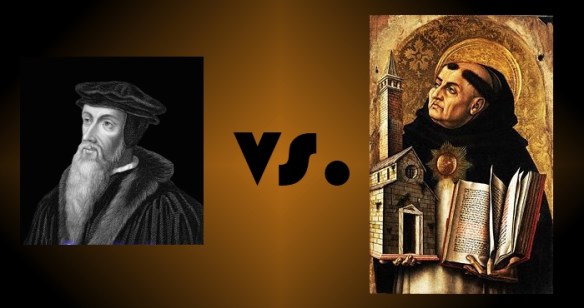
I once remember hearing that not only was the predestination of John Calvin not unique, it wasn’t even controversial among the deeper thinkers in Christian history. In fact, no less than Thomas Aquinas (1224-1274) could said to be something of a “5 Point Calvinist!”

The idea that Aquinas had a clear and strong view of predestination should be beyond dispute. No only does Aquinas’ masterpiece, Summa Theologica, contain several pertinent sections related to predestination, but Robert Mulligan translates several other relevant sections from his writings in Thomas Aquinas: Providence and Predestination (Chicago: Henry Regnery, 1953). He can say things like, “Clearly predestination is like the plan, existing in God’s mind, for the ordering of some persons to salvation. The carrying out of this is passively as it were in the persons predestined, though actively in God. When considered executively in this way, predestination is spoken of as a ‘calling’ and a ‘glorifying’, thus St. Paul says, ‘Whom he predestinated, them also he called and glorified.'” (Mulligan, 164).

But can Aquinas account as a 5 Point Calvinist? I rooted around for some quotes, and all of the following come from the Summa unless otherwise noted. Any emphasis is added by myself.

Total Depravity

“I answer that: Man’s nature may be looked at in two ways: first, in its integrity, as it was in our first parent before sin; secondly, as it is corrupted in us after the sin of our first parent. Now in both states human nature needs the help of God as First Mover, to do or wish any good whatsoever, as stated above. Continue reading

Resources for Preaching on Galatians

For the weeks leading up to December 25 (what the un-RPW world calls otherwise known as “Christmas” & “Advent”), we’re taking a 30,000 ft aerial flyover of the book of Galatians. Thinking especially that God sent His Son “in the fullness of time,” we’ll be using Galatians as a foil for considering Christ – and His benefits – that have come to us in these last days where we have the fullness of Christ. Topics like justification, adoption, freedom, covenant, the apostolic ministry, sanctification, and the Gospel will be addressed. And with the short window we’re giving ourselves, along with the 30k ft approach, that means I have to be pretty concise; so no, I won’t be doing any extended reflections in this series on “what are the στοιχεῖα τοῦ κόσμου?”Here are some of the resources that I’ve found helpful for thinking about Galatians:
F.F. Bruce’s commentary in the NIGTC series. I love this series (usually) and I enjoy Bruce. Continue reading

Switching to Galaxy SII

I haven’t been able to put much interesting up here lately with too many other family and work commitments going on, and for some of those I’ll talk put some video and pictures up in the future. But one thing that took up a few days was running the whole family up to the Twin Cities, and on our shopping plan was to update our phone plans. My friends tease me for still being on T-Mobile (I think we were like their first customers in 1999), and for being so chintsy with our phones.
But all of that changed on this trip, when we fully updated our contracts, our handsets, and got caught up with the 21st century. I went with the pictured Samsung Galaxy S2, and my wife got the Tmobile G2x.

T-Mobile has been in the news a lot for their infamous buy-out from AT&T. But with this visit, at least, we saw a lot to like at T-Mobile. Continue reading

The Technical Is Pastoral…

technical_work…and the grammatical is applicable. In his very good series “How Seminarians Can Learn to Preach to Normal People” (Part 1, Part 2, Part 3), Tim Raymond offers the following, generally true advice:

…Learn to rely on both exegetical and pastoral commentaries… Exegetical commentaries, such as the NICOT or the NIGTC, tend to query the text by asking grammatical, linguistic, historical, and text-critical questions such as, “What is the significance of this aorist?”, “Was this passage in the autograph?”, “How does this verse correlate with what we know from Phoenician archeology?”, and so forth. Pastoral commentaries, such as John Owen on Hebrews or James Boice’s commentaries, tend to ask theological, devotional, and spiritual questions of the text such as, “How does this passage feed my soul?”, “How might this passage help my congregation endure through suffering?”, “How can God’s Spirit actually enable me to obey this command?,” and so forth… What I’m arguing for here is that if a pastor wants to do responsible expositional preaching to ordinary people, he needs to rely on both types of commentaries.

I think Raymond is generally right on, and I’ve enjoyed reading his series. But I would like to nuance this; not by bifurcating the academic from the practical, but rather pointing out that excellent application derives from solid, technical exegesis. So instead of saying: “Is this an aorist?” and “How does this apply to families?” as two separate questions, let us instead ask one question: “What does the fact that this verb is an aorist say to the families in our congregation?” To quote somebody else, the Bible is already practical. Its the prepositions, grammatical constructions, and first-century context that helps us to understand how it is practical.

I think Raymond is basically saying this. He later notes, “Since all pastoral application is dependent on right exegesis, the faithful preacher will need to use academic commentaries to ensure proper interpretation.” This is probably only a difference of emphasis. But the emphasis I’m trying to make says that the exegesis itself is what is practical.

How to Listen to Bad Sermons

Dear Zion,
We have spent some time thinking about the importance of sermons in the regular, spiritual diet of God’s people, including how to hear a sermon, and also how to live from a sermon. But this all assumes that we are hearing good sermons to begin with. What should we do when we listen to a bad sermon?

Scripture tells us that there are some sermons so bad, we should not listen to them. When Paul soberly warned and admonished Timothy “to preach the Word” (II Timothy 4:2), the emphasis must be retained: a sermon is only a useful sermon if the content is the Word of God. Paul himself resolved to “know nothing except Jesus Christ and Him crucified” (I Corinthians 2:2). Unfortunately, we live in a day and age where the content of many (most?) sermons do not rely on God’s Word and His power, but instead rely on the preacher’s experiences, storytelling, practical suggestions, and eloquence. The preacher may even begin with a Bible passage, but the content of the sermon that follows is not coming from sacred Scripture. If sermons today were edited down to only “Christ and Him crucified,” how much would be left?

Similarly, Paul warned Timothy that there would be a time when “people will not endure sound teaching, but they will gather around them a great number of [preachers] to say what their itching ears want to hear, to suit their own desires” (II Timothy 4:3). Continue reading

The Problem with Most Bible Studies

You know that feeling you get when someone perfectly describes something you have witnessed or seen dozens of times, but never been able to articulate yourself? I had that feeling as I listened to Christian Smith describe the average, American Evangelical Bible study. The following quote is taken from an interview at The White Horse Inn:

Basically, what gets reported [by anthropologists studying evangelical Bible studies], and what I think I agree with, is:
The text is read, umm… what the text actually says is not all that much paid attention to. People, rather, sort of search around in their heads and their memories and their feelings for something that seems to connect to the text. And then, they conclude, “Oh yeah, well that makes me feel like this…” or, “What I think is that…” or, “In my opinion what it means is this…” And usually, the text is serving as a pretext to affirm something they already believe, rather than as an authoritative text to challenge what they already believe.

Nailed it.