And in my best behavior
I am really just like him
Look beneath the floor boards
For the secrets I have hid
*sigh*
John Wayne Gacy Jr. // Sufjan Stevens
And in my best behavior
I am really just like him
Look beneath the floor boards
For the secrets I have hid
*sigh*
John Wayne Gacy Jr. // Sufjan Stevens

I was honored to have an article in the Clear Lake Classical newsletter last fall when school started, but forgot to link it. Now that we are starting a new calendar year, much of the advice seems pertinent again. You can find the original newsletter (and subscribe!) here.
In 1901, the freighter ship SS Hudson left port in Lake Superior, heading east with valuable cargo. But just a few precious hours later, they would fly distress signals, and shortly after that, succumb to a raging storm and sink beneath the waves. A vicious gale plunged the mighty freighter 825 feet down to its watery grave. After just setting out, the Hudson was already sunk.[1]
Welcome to how parents feel, just a few months into the start of another school year: a few weeks in, and we are ready to fly distress signals before we go down with the ship!
The hectic schedules, filling the children’s lunch boxes, making sure everyone gets to practice, brushes their teeth… it is enough to keep even the most disciplined family scatter brained. And when you attend a rigorous school like Clear Lake Classical, how do you keep on top of it all?
Let’s see if CLC’s twin emphases on classical education and being Christ-centered can help overwhelmed families with the busy pace of life.
One of the blessings of a classical education is that our students glean the wisdom of the ancients. We don’t have to reinvent the wheel with “new math” or the latest teaching style. We see what has served us well in history, and we wisely borrow those timeless truths and apply them in meaningful ways to today.
To respond to the scarcity of time, wise families will want to consider the ancient Stoic practice of habitus (habits) and rhythm. The founders of classical education knew how life could easily spiral out of control, and so they fought back by practicing daily habits and rhythms. Epictetus (55 – 135 AD) once said, “every habit and capability is confirmed and grows in its corresponding actions, walking to running, and running to sprinting . . . therefore, if you want to do something, make a habit of it.”[2] Habits make up our routines of days, weeks, months, and years. The better the routine, the more joy we will see.
Many of us feel pressure from deadlines: the kids need to be to school on time; and piano practice on this day; and don’t forget the after-school activities. But there is wisdom in not being pulled away by the tyranny of the urgent, and instead settling into routines – rhythms of life – to guide us. Seneca (4 BC – 65 AD) famously said, “If a person doesn’t know to which port they sail, no wind is favorable.”(3) Good habits help to ground our busy schedules to get us to the best destination. Later, Seneca commented, “We’re tight-fisted with property and money, yet think too little of wasting time, the one thing about which we should all be the toughest misers.” Time is one of our most valuable commodities. Understand habits as wise investments in your own time!
You can probably already identify several routines in your life: work schedules, after-school pick up, and Sunday worship. Carefully observe your calendar and your time. What habits or rhythms are already happening in your schedule? Are they necessary? Are there rhythms and habits you would like to include? If so, what steps would need to be taken to realize these new patterns of time in your life? A classical understanding of our schedules can help us take control of our time in a hectic and fast-paced culture.[4]
Getting into a healthy rhythm is important, but if we don’t see life’s events through the proper perspective, we will be prone to discouragement, or being ungrateful. Great thinkers from the past encourage us to see things more clearly.
Marcus Aurelius (121 – 181 AD) wrote in his Meditations that “Man is not disturbed by events, but by the view he takes of events.”[5] In other words, it is not so much what happens to us, but how we see and respond to these events.
Suppose you have a big work presentation, but that morning your child wakes up sick, you forget your phone, the car is running on fumes, and your boss is in a foul mood. It would be easy to get discouraged or feel hopeless about what you need to get done that day.
But a classical view encourages us to look at it differently. Many things – a sick child, a grumpy boss – are outside our control. Instead of worrying or agonizing over these, we realize we have the responsibility to maintain our composure, and not let these outside, external factors overwhelm us. Rather, we have a responsibility to what the classics called the summum bonum, “the highest good.” In the face of everything we cannot control, we should strive for the highest good we can do in the situation facing us. Marcus wrote, “Just that you do the right thing. The rest is of no great matter.”
As for the things we can control – an empty gas tank, or losing your phone – we should practice premeditatio malorum, or “planning ahead for what could go wrong.” Many of the things that go wrong in life are simply due to negligence, or not planning for the worst. The Stoics were realists, and expected things might not go the way we always hope. Once we planed for the worst, and sought the highest good, then we could possess amor fati, “a love of what will come next.” We might not be able to control the future, but we can see the events in our lives in a clear light.
Do you see the year ahead clearly? What are your hopes for your children at CLC? Is it merely to get through the next year, or to thrive and flourish? Will you allow external factors dictate your joy for the year ahead, or have you looked hard at what is in your control, what is outside of it, and how you can joyfully move forward in it all? Continue reading
 Of course, Christians are commanded to “pray without ceasing” (I Thessalonians 5:17), and that grace should be pursued all the more at the start of a new year. May the following prayers encourage you for the year ahead!
“O LORD,
Length of days does not profit me except the days are passed
in thy presence, in thy service, to thy glory.
Give me a grace that precedes, follows, guides, sustains,
sanctifies, aids every hour,
that I may not be one moment apart from thee,
but may rely on thy Spirit
to supply every thought,
speak in every word,
direct every step,
prosper every work,
build up every mote of faith,
and give me a desire
to show forth thy praise,
testify thy love,
advance thy kingdom.
I launch my bark on the unknown waters of this year,
with thee, O Father, as my harbor,
thee, O Son, at my helm,
thee, O Holy Spirit, filling my sails.
Guide me to heaven with my loins girt,
my lamp burning,
my ear open to thy calls,
my heart full of love,
my soul free.
Give me thy grace to sanctify me,
thy comforts to cheer,
thy wisdom to teach,
thy right hand to guide,
thy counsel to instruct,
thy law to judge,
thy presence to stabilize.
May thy fear be my awe,
thy triumphs my joy.
—Arthur Bennett, editor. The Valley of Vision: A Collection of Puritan Prayers and Devotions. Carlisle, Pennsylvania: Banner of Truth Trust, 1999 (first published in 1975), p. 112. ISBN 0-85151-228-3.
“Most Merciful Lord, the Ancient of Days,
Moved by your grace, we devote ourselves to you at the beginning of this year desiring to employ it better than we have done in the years that are past. And since this day also warns us that our years pass away like a flood, like a dream, give us grace that we may seriously number our days, that we may have a heart of wisdom, that we may discern the vanity of this life, and that we may aspire to that better life, when days and months and years shall be counted no more, forever. While we continue in the flesh, may we more and more live, not according to its desires, but according to your will. And grant, O God, that when our years shall come to an end, and the day of our death arrives, we may depart in the peace that passes all understanding and in the sure hope of life everlasting. Favorably hear us through Jesus Christ our Lord. Amen.”
Personal prayer from Psalm 90 (source)
Continue reading
 “Theology carries with it a unique mode of existence. Barth and his followers referred to this as a theologische Existenz (theological mode of existence).
This theological mode of existence involves more than acquiring a substantial amount of knowledge, more than doing theology as creatively as possible. It concerns the cultivation of a certain underlying passion.
This passion is, first, a passion for God and His kingdom. As the word indicates, a true theologian speaks about God. But his or her passion also concerns the people of God and the world of God. This dimension will perhaps not radiate from every page the theologian writes. It is a cultivated passion; that is, it lies in the background and will typically surface in a restrained manner.”
C van der Kooi & G. van den Brink Christian Dogmatics: An Introduction p. 29-30
The following article by Josh Mcpherson was originally posted at Christian Family Matters, but the link is now dead. It is posted here as a placeholder for links.

I don’t want to be a good dad—I want to be a great dad.
But the longer I live and more ministry I do, the more I have come to realize there are precious few examples of grace in action when it comes to fatherhood. So on this Father’s Day, I wanted to take a moment, heed Paul’s exhortation (Eph. 6:1), and honor my own father, Greg.
Was he perfect? Nope.
Did he make mistakes? Sure.
Does he wish he could do things differently? I have no idea.
But in a land where few men finish well when it comes to the daunting task of fatherhood, I’ve found myself reflecting and marveling at the grace of God in my dad’s life. He loved Jesus, repented often, and poured his life into his two sons. How much more could a boy ask for?
In your life, Dad, I have found a roadmap for my own role as father. So I wanted to take a few moments, and tell you thanks from the heart of a grateful son. Specifically, thank you for . . .
Not once. You never made fun of me, mocked me, or talked about me like I wasn’t there. Never was I the butt of your jokes. In everything you built me up, encouraged me, and moved me forward. You always spoke of my future with great hope. “The Lord will give you great opportunities, Josh. Jesus has great plans for you, son.” This sort of prophetic encouragement every boy needs, and I got it in bushels. Thanks, Dad.
. . . the night I screamed in agony from growing pains. I was eight. You were half asleep. Tripping on a toy you went sprawling across the room in your underwear. We both burst out laughing. Then you rubbed my leg-cramps for an hour. I slept in the next day; you were up at 5 a.m. and out the door. You put my need to be comforted in front of your need for sleep. Thanks, Dad.
You loved Jesus passionately and it drew me in.
. . . and crying in front of me often. It’s good for a boy to see both. I’ve seen you cut down trees, fix tractors, build things, and tackle gut-wrenching church conflict with unflinching courage and razor-sharp biblical clarity. I’ve also seen you listen intently, hug often, and tear up quickly when moved by someone’s pain or God’s grace. Not the helpless, whimpering, cowardly sort of tears—the genuine, earnest, heartfelt tears of a man who feels and thinks deeply. You cry easily when talking about Jesus, the gospel, redemption, and the day God called you into ministry. I love that. Thanks, Dad.
I never felt more safe and loved than when held in your arms.
. . . and singing loudly with the church. I distinctly remember as a young boy looking up and seeing tears roll down your cheek during worship. I couldn’t articulate it then, but I knew that you were singing to someone who meant everything to you, who was great and big and awesome and worthy of your allegiance, and who gave you great joy. That is a gift to a young man. You didn’t tell me to love Jesus passionately—you loved Jesus passionately and it drew me in. Thanks, Dad.
Continue reading
This article originally appeared at Ekklesia Muskogee, but has since gone missing on the internet. Posted here as a placeholder.
There’s no shortage of parenting books out there. But you’ll find very few dedicated to the subject of fathering. What does it look like to father well? Thankfully, God’s word includes much guidance for fathers. The Bible is filled with good dads (starting with God the Father) and bad dads (starting with Adam, our first father). Proverbs is in large part a collection of wisdom written by a dad to his son. In his letters to Timothy and Titus, Paul offers profound direction as aspiritual father.
Elsewhere in Scripture, Paul warns fathers: “Do not provoke your children to anger, but bring them up in the discipline and instruction of the Lord” (Eph. 6:4). Dads, this is our God-given job description. We must strive to fulfill it “according to the power at work within us.” For starters, it helps to think about what the verse means. Both parts of the verse are equally important—do not provoke and do bring them up—but understanding what it looks like to “not provoke your children to anger” is arguably less obvious. In order to help, here are some examples of ways dads can provoke their kids. By God’s grace, father your children by avoiding these pitfalls:
Encouragement is a deposit; criticism is a withdrawal. We provoke our children to anger when we make far more withdrawals than deposits. When it comes to encouragement, don’t be stingy with your kids. Say things like:
In addition to verbal affirmation, write them notes, send them texts, pull them in for a hug and a kiss on the forehead. Inevitably, as fathers we’re going to make withdrawals because our kids will sin and we’ll need to address that. But we provoke our children to anger when all we do is point out the flaws and fail to provide any solutions or hope. We need to be their coach, not their critic.
Fathers provoke their children to anger through physically using their size advantage. This could be physical—hitting, shoving, kicking, intimidation—or verbal abuse. Some fathers goad their children. They’ll shame their kids in front of other children by saying things like, “You’re so stupid,” “You failed again,” “You’re fat,” “You’re an idiot,” and “You’re a loser.” Such violence is sinful, reprehensible abuse that shapes an identity that is death for the child. Some either grow up to rage against their parents, particularly their father, or they just leave.
Whether it’s intentional or not, some dads do everything they can to avoid engaging their children. You’re always doing something and can’t be interrupted, whether that’s woodworking, fixing the car, doing yard work, using your phone, or watching TV. You’rephysically present but emotionally absent. Dad never gives hugs or says, “I love you.” A lack of emotional attention
provokes a child to anger. Imagine a child who craves emotional attention and appropriate physical touch from dad. He never offers his affection, and so eventually the child starts looking elsewhere, out of frustration and desperation. For a daughter especially, this can leave her in a very dangerous position.
Read more: 7 Ways Fathers Provoke THeir ChildrenRather than pulling a child out of the fray for a loving, heart-to-heart talk to address some issue, fathers provoke their children to anger by cutting them down in front of their family and friends. When it comes to correction, we can belittle our children in an attempt to shame them into submission, or we can provide them a vision of the man or woman God is calling them to be, saying, “I see in you these gifts, abilities, godliness, and maturity. What you’ve done grieves Jesus and it grieves me. But I’m here for you, and I want to help you grow.” In this way, our communication becomes a loving invitation rather than harsh castigation.
Some dads are just no fun. They don’t know what to do with a Popsicle, a whiffle ball, a swimming pool, or a bike. Kids should have predominant memories of enjoyable times with their dad. Which means when your kids are little, you have to be silly. You’re going to wear some outlandish outfits. You’re going to sit in on some tea parties. You’re going to wrinkle your clothes during living room wrestling matches. If a dad is making memories, if he loves his kids and they know it, when it comes time to discipline them, it will be in the context of a dad who loves them. God our Father is like that. Proverbs says it and Hebrews repeats it: “For the Lord reproves him whom he loves, as a father the son in whom he delights” (emphasis added).
I learned generosity from my Grandpa George. We were very close. He lived in a cul-de-sac, and he had a rule: whenever the ice cream man comes around, run out and stop him. Grandpa George would then have us invite all of the other kids in the neighborhood over, he would tell everybody to order whatever they wanted, and then he would pay for it all. When the ice cream man came, I’d get excited, all the kids would get excited, and I’d look at my Grandpa George’s face, and he was happy. He was happy because he liked to be generous. That’s the heart of a father. That’s the heart of God the Father.
Did you have a hypocritical dad who pointed out your sin but never admitted to any of his own? How frustrating was that? As fathers, we’re going to sin against our kids. You’re going to bust them for something that they didn’t do. You’ll fail to listen. You’ll blow it. What do you do? Repent. Go to your kids and say, “Dad’s a sinner. I was wrong. I’m really sorry about what I’ve done and the way it’s affected you. Would you please forgive me?” Fathers, we don’t need to be right; we need to prove to our children that God is always right, and sometimes that means we’re wrong. We are not only an earthly father, we are an earthly father who needs their heavenly Father.
Fathers, we have a sacred responsibility. If the Holy Spirit is in you, you’ll want to become a father like God the Father, and bless your children the way he has blessed you. We cannot do this apart from his grace and power—praise God we can rely on his wisdom and strength rather than our own.
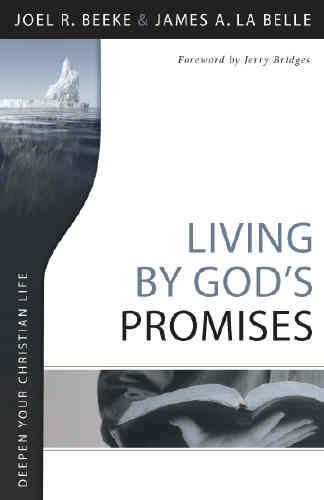 A beautiful section from Living By God’s Promises:
That obedience is commanded is clear… On what basis does the apostle give such a command [from Romans 6:12 – 13, “Let not sin therefore reign in your mortal body, to make you obey its passions. Do not present your members to sin as instruments of unrighteousness, but present yourselves to God as those who have been brought from death to life, and your members to God as instruments for righteousness.”]?
Surely the apostle does not believe man is able in himself to obey, for he has already given over all men to sin (Rom. 3:9 – 20) and would not contradict that truth here. Neither does he believe that we are able in ourselves to obey, for the very point of Romans 6:1 – 11 is that just as our union with Christ’s death has freed us from sin’s dominion, so our union with Christ’s resurrection has freed us to obey. Therefore, our holiness cannot even be considered outside of Christ, in whom we enjoy it. Holiness, or obedience to God’s imperatives, is not something we enjoy because of Christ, but rather something we enjoy in and from Christ (Rom 6:11 – 12). Our acceptance before God is therefore *in* Him (Eph 1:6) and not *because of* Him. The latter viewpoint suggests that Christ brings us to a place of holiness by which we can stand before God on our own, while the former states that Christ, by redemption, so unites us to Himself as the beloved of God that we stand before God in Him… We obey the imperatives of the gospel because we enjoy the indicatives of the gospel.
p. 130
One small quibble. Why distinguish between in Christ, as if it were opposed to because of Christ? Surely, Beeke et al do not mean to suggest that it is “because of” something else other than Christ. Often, “because of” can suggest the logical or causal ground, and I highly doubt Beeke thinks there can be any other ground than Christ our Lord. Further, I do not think “because of” can mean “[I] can stand before God on [my] own.” I’m perfectly happy with Beeke’s explanation (“The latter viewpoint…”), but I would have never thought to contrast in with because of.
Despite that quibble, there is so much beautiful, life-giving, truth summed up in just a few short verses! What I first learned in Owen, I see with such precise and clear wording here. Far too many Christians today have “found Jesus for forgiveness,” but then labor in their own power & person for obedience. They have not connected Gospel indicatives to the imperatives. I know what joy it has brought to my life, and the transformation He has wrought, to see myself laboring for the Lord in a power that is not my own, but His grace within (I Corinthians 15:10)! And this has come in union – abiding in, dwelling with, meditating on – with the risen Christ.
 I just got notice that the #BCSPasCon app is now available to as a FREE download from both Google Play and the App Store. Or, simply search “2019 Bethlehem Conference” and it should come up.
From the app you can:
Connect with other attendees • Post on the activity stream • Read speaker bios • Browse the complete schedule • Read about your favorite exhibitors • Track #BCSPasCon on Twitter • And much more!
The conference is Jan 28 – 30. If you’re going, I’d love to connect with you!

Clear Lake Classical recently ran the fall edition of their newsletter, and I was honored they would accept an excerpt from one of my articles on classical education. Want to see the full newsletter?! Sign up here!
Another painful conversation. Another hurting set of parents.
The mother of a bright 6th grader looked at me, mournfully. “We just want school to make sense for where their lives are going,” she said. “If they come on [the family farm],” her husband added, “I don’t want [my child] to have spent years in school learning something different than who we are every day in our home.”
Education should “make sense.” Learning ought to help our kids “be who we are every day.” I’ve heard these concerns voiced, emailed, and prayed for many, many times.
Yet for many families, there is a growing concern that education has been disconnected from what we want for the next generation. Do the hours spent in various classes actually prepare young minds for the skills they will need? Do the values they pick up – on the playground, in the lunch line, or on the bus – shape them into the godly adults we pray they will become? Growing up in Minnesota, and now living in Iowa, it is easy to see that Midwest families value education that integrates knowledge and values that will be practical for our children’s future. Continue reading
 Sometimes you run out of room or time in your Lord’s Day sermon, and so “Monday Morning Pulpit” is a chance to expand upon or reinforce ideas you didn’t have a chance to finish during the sermon.
On Resurrection Sunday, I preached from Hebrews 2:14 – 15; “that through death Christ might destroy the one who has the power of death, that is, the devil, and deliver all those who through fear of death were subject to lifelong slavery.” The following Athanasius quote is MONEY for the sanctification of the fear of death, but I wasn’t able to read the whole quote in the sermon. Enjoy!
“For that death is destroyed, and that the Cross is become the victory over it, and that it has no more power but is verily dead, this is no small proof, or rather an evident warrant, that it is despised by all Christ’s disciples, and that they all take the aggressive against it and no longer fear it; but by the sign of the Cross and by faith in Christ tread it down as dead. For of old, before the divine sojourn of the Saviour took place, even to the saints death was terrible, and all wept for the dead as though they perished. But now that the Saviour has raised His body, death is no longer terrible; for all who believe in Christ tread him under as no naught, and choose rather to die than to deny their faith in Christ. For they verily know that when they die they are not destroyed, but actually [begin to] live, and become incorruptible through the Resurrection. And that devil that once maliciously exulted in death, now that its pains were loosed, remained the only one truly dead. Continue reading
 Brian J. Lund