Advent Liturgy


The purpose of this liturgy is to direct the people of God as they are served by their Covenant God who condescends to our weakness in the Incarnation, and who visits us with perfect justice in the Final Judgment. These two advents frame the experience of New Covenant believers: we look back to Christ’s first coming and look forward to His Second. We live by faith based on the First coming, by hope looking forward to the Second, and the fruit of love in the mean time. We receive grace from the Cross, which leads to good works of gratitude for the Bema Seat. We worship the risen Christ, listening to Him through ordained servants because He is ascended, but praying “Marana tha!” because He has promised to come again.

See Lehigh Valley PCA’s Advent Liturgy for another take on how to conduct Covenant Renewal during the advent season.

Divine Service of Worship

Preparation for Worship
Prelude
Welcome & Announcements
Introit
Scripture Reading and Lighting of the Advent Candle[1]
Passing of the Peace

Call to Worship[2]
Call to Worship
Prayer of Invocation
Votum
Hymn of Praise

First Advent
Scripture Reading[3]
Christological Creed[4]
Congregational Prayer[5]

Charter of Faith
Choral Exhortation
Children’s Sermon
Giving in Tithes & Offering
Gloria Patri
Prayer of Thanksgiving
Singing of a Psalm
Pastoral Prayer & Lord’s Prayer

Ministry of the Word
Scripture Reading
Prayer of Illumination
Sermon
Prayer of Application
Hymn

Communion
Exhortation & Excommunication
Words of Institution
Holy Eucharist

Second Advent
Scripture Reading[6]
Congregational Prayer[7]

Commission
Song of Response
Benediction

_______________________________________
[1] The lighting of the Advent candle is not a circumstance of Scripture reading or any other aspect of worship, and is certainly not an element, and therefore does not belong to the service of worship proper. Our tradition is to have different families come forward, with the head of the household reading select Scripture passages highlighting the advent of Christ, while his wife or child lights the appropriate candle.
[2] Our Call, Charter, Word, Communion, and Commission sections of the liturgy follow our common Covenant Renewal liturgy, and so won’t be explained in detail. Some of the order is changed due to the nature of flow in the historia salutis.
[3] These Scripture readings, spoken by a Ruling Elder, will focus on one of the facets of Christ’s first coming. For example, the First Sunday in Advent includes Genesis 3:15, Isaiah 27:1-6, and Luke 10:17-24 to focus on Christ’s destruction of the Evil One.
[4] Jesus asked Peter to confess His identity in Matthew 16:15-16, and just as Christ gave a good confession, so His disciples are to confess His name before men (I Timothy 6:12-13). These corporate confessions of faith will feature the historic Christian and Reformed creeds, confessions and catechisms. Our Advent Sundays will employ the Nicene and Athanasian creeds, the Definition of Chalcedon, the Belgic Confession, and the Heidelberg Catechism.
[5] We pray for Christ’s coming to forgive our sins, transform us, and use us for His glory. A sample prayer is as follows:

Almighty God, give us grace that we may cast off the works of darkness, and put upon us the armor of light, now in the time of this mortal life, in which Your Son Jesus Christ came to visit us in great humility; that in the last day, when He shall come again in his glorious Majesty, to judge both the quick and the dead, we may rise to the life immortal; through him who lives and reigns with You and the Holy Ghost, now and ever. Amen. 

[6] This Scripture reading focuses us on Christ’s Second coming. For example, II Thessalonians 1:7-12 directs us to Christ’s coming in judgment but also salvation.
[7] A concluding, congregational prayer for us to direct our pleas and petitions to our coming King.

Celebrating Advent

Dear Zion,

You’ve probably noticed that we have begun a special season at church called “Advent.” This word comes from the Latin, adventus, which means “coming,” but both of these words help us understand the biblical word parousia, a word we see in I Thessalonians 3:13, “the coming of our Lord Jesus.” Advent is an opportunity to remember that Christ came into the world “for us and for our salvation.” How can we as Christians benefit from the season of Advent? What can we do to remember “the reason for the Season?” How should we “keep Christ in Christmas?” Let me offer some suggestions.

First, we should meditate on Christ’s first coming. Jesus didn’t come into this world unbidden and for no reason. Rather, Jesus was “sent by the Father” (John 5:36-37). Even being born as a babe in the Bethlehem manger was an act of obedience by the Son to God the Father. Jesus’ obedience is imputed to us by faith (I Corinthians 1:30), so that we may also be obedient to our heavenly Father. But why did the Father send Jesus? Jesus was sent to destroy Satan (I John 3:8), to save us from our sins (I Timothy 1:15), to bring life and light into the darkness (John 1:4-5, 9), for the glory of God (John 7:18), and to serve us and give His life as a ransom for His people (Mark 10:45). Meditating on Jesus’ first Advent should drive us to be Christ-lovers who desire to lay down our lives to serve our neighbors so that we could obey and glorify God!

Secondly, we should look in hope for Christ’s second coming. Though we normally think of Advent with regard to Christmas and Jesus’ birth, the word parousia usually refers to Jesus’ second coming (I Thessalonians 2:19; James 5:8)! Like Abraham, Moses, David, and the saints of the Old Testament, we are waiting for the appearance of the Messiah, even Jesus Christ (I Peter 1:10-14). However, unlike those Old Testament saints who died before Christ came the first time, we “rejoice with joy that is inexpressible and filled with glory” because we already know Christ by faith in Holy Scripture (I Peter 1:8). Because we too are waiting for Jesus’ Advent for the second time, we are to live with patience, faith, meekness and righteousness, shining like stars in a dark world. As we celebrate this Advent season, we should remind our neighbors that Jesus has come as a Suffering Servant, and He will come as our Judge and King. This should make us confident in our faith and humble before others.

Many people will give you other laundry lists to “keep Christ in Christmas.” They’ll tell you to never sign your Christmas cards with “Xmas” or “Happy Holidays,” to boycott certain stores, to put a certain Nativity scene in your yard, to only promote certain non-profit ministries, etc., etc., ad infinitum ad nauseum. But what if I sign all my Christmas cards just so, avoid the “wrong” stores in favor of the “right” ministries, and decorate my house with just the right number of Christmas-light-angels, but don’t have Christ’s love in my heart? Have I really “remembered the reason for the Season?”

This Christmas and Advent season, may we be a people who seek the Lord through prayer, looking to Him to create within us the joy of Jesus’ first coming and the hope of Christ’s second coming. Let’s “keep Christ in Christmas” by avoiding commercialism and consumerism, but also by trusting in God’s grace to work powerfully within us to produce the fruit of the Spirit.

Trusting with you in the Christ of the First and Second Advents,

Pastor Brian

Headline: The Marks of the Church

Featured

The Marks of the Church. Notes on the Notae to Distinguish the Bride of Christ.

Tertullian: “Those are the true churches that adhere to what they have received from the apostles.”

I was recently preparing for a Consistory meeting and we were going to talk about the third mark of the Church, and as I was preparing I started noticing diversity amongst some of our Reformed fathers. Wanting to understand a bit better the exegetical basis for some of the different decisions, I began to catalog various confessional documents and theologians on the matter. I thought others might find it useful to see these findings placed side by side, and so you will find them below in chronological order. No doubt, others ought to be added to this list, and if there is anyone of particular importance that ought to be cataloged, either for their uniqueness or influence, leave a note in the comments and I’ll try to track them down and add them to the list.
Continue reading

Happy Reformation Day

Reformation Day 2010

Yesterday was Reformation Day, the celebration of when, in 1517, an obscure and unimportant German monk named Martin Luther nailed his “95 Theses” to the door of the Wittenburg church. We celebrated God’s grace in His Church by holding a special worship service. The liturgy we used is posted below, following a quote concerning the Reformation rediscovery of grace:
Continue reading

O’Connor, Dark Grace & Transformation

Dear Zion,

It has been a pleasure to meditate with you over “the sign of Jonah” (Matthew 12:39) as we have studied this wayward prophet in our series The Gospel According to Jonah. One of the things that has struck me in studying this book of the Minor Prophets is the way God’s grace in Jonah’s life so often has a dark character to it. I wonder – are you comfortable with the “dark grace” of God?
Continue reading

J.I. Packer’s Introduction to Owen’s Death of Death

“Introductory Essay”
to John Owen’s Death of Death in the Death of Christ
J. I. Packer
_________________________________________________
I.

The Death of Death in the Death of Christ is a polemical work, designed to show, among other things, that the doctrine of universal redemption is unscriptural and destructive of the gospel. There are many, therefore, to whom it is not likely to be of interest. Those who see no need for doctrinal exactness and have no time for theological debates which show up divisions between so-called Evangelicals may well regret its reappearance. Some may find the very sound of Owen’s thesis so shocking that they will refuse to read his book at all; so passionate a thing is prejudice, and so proud are we of our theological shibboleths. But it is hoped that this reprint will find itself readers of a different spirit. There are signs today of a new upsurge of interest in the theology of the Bible: a new readiness to test traditions, to search the Scriptures and to think through the faith. It is to those who share this readiness that Owen’s treatise is offered, in the belief that it will help us in one of the most urgent tasks facing Evangelical Christendom today—the recovery of the gospel. Continue reading

Making a Splash

Ok, so this is more than a little embarrassing. But its better than the actual paper, which had some crack in the title about me “assuming” the pulpit. Don’t they know me? I don’t assume anything.

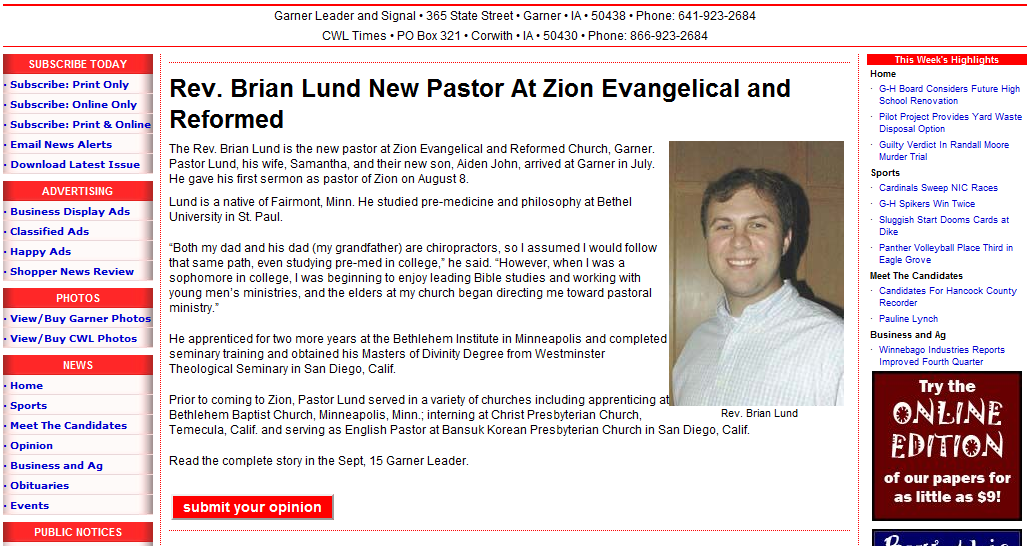
The Garner Leader ran a story about my family and I coming to town and getting going at Zion. You can read the full interview that was conducted here. If you want to read the rest of the article, you’ll have to go over to the website and subscribe, as the whole article isn’t online (boo!).

Seeing this mug on the front page of a newspaper (did I mention the size of Garner?!) is a little disconcerting. (Please, no cracks about seeing my picture in the Police section. The chief of police worships with us.) It was an enjoyable experience, but it left me wondering: who knows how to interview a pastor better – the pastor or the interviewer? I can think of all sorts of interesting questions to put to theologians, but the question is if they would be interesting to anyone else. In this case, isn’t the interviewer the generalist, yet a specialist at interviewing?

Church Ministry and Spiritual Gifts

Dear Zion,

We have enjoyed our time with you this summer, and now as we turn toward autumn all sorts of new activities will be starting at the church.  Pioneer Club, New Life, Confirmation, Bible studies… there is a lot to keep everyone busy!  Of course, the fall also means that we will be electing new officers and leaders in various new capacities – consistory, Sunday school teachers, and Bible study leaders, etc.  So what ties all these things together?  Spiritual gifts!

Spiritual gifts are what the Holy Spirit gives to believers to empower and enable them to serve in the life of the church.  1 Peter 4:10 – 11 says, “As each has received a gift, use it to serve one another… whoever speaks, speak as if you were speaking the oracles of God; whoever serves, serve in the strength God supplies, that in everything God may be glorified through Jesus Christ.”  Sometimes the topic of spiritual gifts can become divisive, but this passage clearly shows that we are to use our gifts from the Spirit to serve the body of Christ to the glory of God!

Spiritual gifts are one of the things that Jesus purchased by His blood in His death on the cross (Ephesians 4:7 – 11).  The Spirit of Christ then distributes those gifts as He pleases through the body of Christ, the Church (I Corinthians 12:11).  All believers – whether young or old, new Christians or mature in the faith – are given spiritual gifts.  You don’t need to have a special experience or be a certain kind of Christian to receive spiritual gifts.  Simply trusting in Jesus supplies you with everything you need!  In fact, God commands all Christians to zealously seek the highest gifts (I Corinthians 14:1).

So what gift do you have?  There are several lists of gifts mentioned in Scripture: Romans 12:6 – 8; I Corinthians 12:8 – 10; 12:29 – 30; and Ephesians 4:11.  They range from gifts as technical as apostles and pastors to as common as “helping” (I Corinthians 12:28) and “speaking the truth in love” (Ephesians 4:2, 15).  And don’t forget how important the “fruit” of the Spirit are; they’re yet another manifestation of the Spirit’s gifting in our lives (Galatians 5:22 – 23)!  All believers are gifted and empowered by the Spirit to serve the body of Christ.

So as we prepare for this fall kick-off season, be praying about how the Holy Spirit has equipped you to serve your brothers and sisters in Christ.  Pray that we would elect those whom the Spirit has gifted for that type of service.  Encourage people to use the gifts that you see evidence for in their lives!  Do you have questions about what gifts you may have?    Do you know where you would like to serve but have questions about how your gifts fit in at Zion?  I’d love to talk with you about how the Spirit is at work in your life!

I’m excited to serve with you in this upcoming year, and I’ll be praying that – as we go forward as a church – the Lord would send His Spirit in power on Zion to guide us forward with all of the gifts that we need for service and ministry.  If we serve in the strength that He provides, it will keep us dependent on our God, so that He may receive all the glory!

Praying that we would serve one another with our spiritual gifts,

Pastor Brian