Calvin’s Ecclesiastical Ordinances

The Genevan Book of Order

The Form of Prayers and Ministration of the Sacraments, etc.
Used in the English Congregation at Geneva (1556)

Of Ministers and Their Election
What Things are Chiefly Required in the Pastors and Ministers

First, let the church diligently consider that the minister which is to be chosen[a] be not found culpable of any such faults which St. Paul reprehends in a man of that vocation,[b] but contrariwise endowed with such virtues, that he may be able to undertake his charge, and diligently execute the same. Secondly, that he distribute faithfully the word of God, and minister the sacraments sincerely,[c] ever careful not only to teach his flock publicly, but also privately to admonish them;[d] remembering always, that if any thing perish through his default, the Lord will require it at his hands.[e]

a. Acts 1:21-23; 13:2-3; 14:23 Continue reading
Brakel on Typology

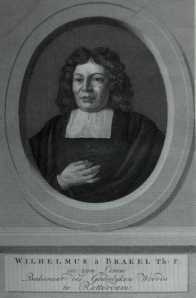
Wilhelmus a Brakel (1635 – 1711) was a prominent Dutch theologian and pastor at the end of the High Orthodoxy in the Netherlands. His magnum opus is The Christian’s Reasonable Service, which is (overall) a marvelous combination of dogmatic and practical theology, certainly in the vein of the Nadere Reformatie tradition. For excellent treatments of the Dutch churchman see Bartel Elshout’s resource-rich site.

Brakel is very careful in describing typology. He argues that, unless clear boundaries are given, every star, tree and worm will turn into a type of Christ at the hands of less-than-skilled interpreters. So he lays down the following rules for a type: “If one is to designate something as a type, the following must be true:”

  1. It must have been appointed by God to be a type.
  2. Types had been given to the church of the Old Testament in order that during that time frame she would thereby look unto Christ and believe in Him.
  3. Types were a necessary component of Old Covenant worship such that those who did not use these types for their intended purpose were in sin.

“When these three criteria are absent, however, one may not appoint or designate something as a type” (Volume IV, p. 382).

At first glance, these seem like excellent rules. Continue reading

Bonhoeffer on Cheap Grace

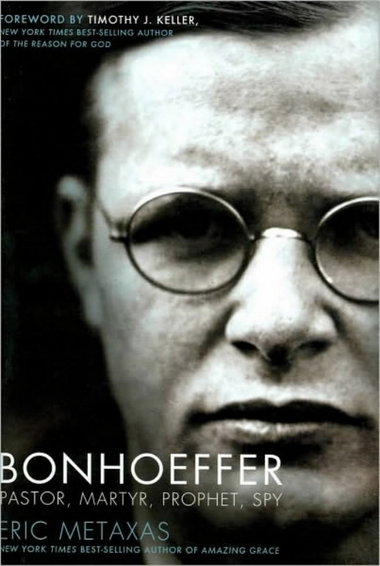
The following are large quotes and snippets from Bonhoeffer’s Cost of Discipleship, pages 45 – 49. A few thoughts afterward.

“Cheap grace is the deadly enemy of our Church. We are fighting today for costly grace… Cheap grace means grace as a doctrine, a principle, a system. It means forgiveness of sins proclaimed as a general truth, the love of God taught as the Christian ‘conception’ of God. An intellectual assent to that idea is held to be of itself sufficient to secure remission of sins…. In such a Church the world finds a cheap covering for its sins; no contrition is required, still less any real desire to be delivered from sin. Cheap grace therefore amounts to a denial of the living Word of God, in fact, a denial of the Incarnation of the Word of God.

“Cheap grace means the justification of sin without the justification of the sinner. Grace alone does everything they say, and so everything can remain as it was before. ‘All for sin could not atone.’ Well, then, let the Christian live like the rest of the world, let him model himself on the world’s standards in every sphere of life, and not presumptuously aspire to live a different life under grace from his old life under sin…. Continue reading

The Athenian Creed

What is the Athenian Creed? Perhaps it is one of the post-Refomration creeds newly republished thanks to Dennison’s or Van Dixhoorn’s work? Or perhaps it is merely an example of Old Side Presbyterianism skewering unbelief and modernism within the Church? If you’re leaning toward the latter, you’d be spot on.

Recently, over at WHI, Mike Horton highlighted the satire that John Witherspoon used to skewer the modernists and Moderates in the Kirk of Scotland. His Ecclesiastical Characteristics, divided into certain “Maxims,” were a hot iron toward his liberal contemporaries.

One such Maxim was his “creed,” a lampooning article of what he considered to be the reigning ideology of the day. Continue reading

Resources on Regeneration

I’m hoping to do some extended thinking (and preaching?!) on regeneration in the next few weeks/months, and I was thinking I should line up a list for reading and meditating on this important doctrine. Unfortunately, it can be a little difficult to find extended discourses on the topic of regeneration. I attribute that to a variety of factors:

    • In the history of doctrine, regeneration has been something of a moving target, especially for Calvin’s successors, where regeneration can mean anything from conversion, repentance, sanctification, or the newer clarification of speaking exclusively of the (initiation of) spiritual life.

Continue reading

J.I. Packer’s Introduction to Owen’s Death of Death

“Introductory Essay”
to John Owen’s Death of Death in the Death of Christ
J. I. Packer
_________________________________________________
I.

The Death of Death in the Death of Christ is a polemical work, designed to show, among other things, that the doctrine of universal redemption is unscriptural and destructive of the gospel. There are many, therefore, to whom it is not likely to be of interest. Those who see no need for doctrinal exactness and have no time for theological debates which show up divisions between so-called Evangelicals may well regret its reappearance. Some may find the very sound of Owen’s thesis so shocking that they will refuse to read his book at all; so passionate a thing is prejudice, and so proud are we of our theological shibboleths. But it is hoped that this reprint will find itself readers of a different spirit. There are signs today of a new upsurge of interest in the theology of the Bible: a new readiness to test traditions, to search the Scriptures and to think through the faith. It is to those who share this readiness that Owen’s treatise is offered, in the belief that it will help us in one of the most urgent tasks facing Evangelical Christendom today—the recovery of the gospel. Continue reading