Sanctification: Ryle vs. Pink?

What role does sanctification play in the Christian life? And specifically, is sanctification necessary for a Christian to ultimately be saved? Sometimes this issue can be confusing for Reformed Protestants who wish to maintain salvation by God’s saving grace from first to last, and yet also trumpet the need for holiness and good works. Even reading erstwhile helpful pastors and expositors can be confusing, as J.C. Ryle and Arthur W. Pink demonstrate. Consider their separate comments:

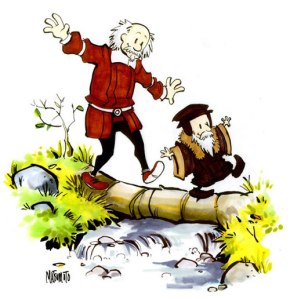
From bottom left going clockwise: Ryle, Pink, Owen, Calvin


J.C. Ryle- “Holiness” pg.28-29

Sanctification, in the last place, is absolutely necessary, in order to train and prepare us for heaven Continue reading

Disagreeing with Calvin

…is not wise to do very often, but it is important. It is not wise, because so often Calvin proves to be right. I can remember Bob Godrey, president of Westminster Seminary CA, talking about how the older he got, the more often he found Calvin to be proven to be correct on various exegetical, theological, or ecclesiastical issues. David Steinmetz has talked about the superiority of pre-critical exegesis, and Calvin’s reflections are remarkably biblical and pastoral. It is rarely wise to disagree with the Reformer.

But it is also important to be able to disagree with Calvin. Continue reading

Finding Tunes for the Text

Dear Zion,

Last time we saw that what we sing to God in our lyrics and musical text is the most important thing for selecting music in worship services. In fact, what we sing even takes precedence over how we sing, or in other words, the tune, arrangement, and harmony. We can all agree that the music should reflect the mood and substance of our songs, but what other guidelines should churches consider when thinking about the musical tune of the text?
Continue reading

Lent Is Not For Getting Closer to God

1. Giving up food or drink or anything else cannot bring you closer to God, no matter if you do it before Easter or in the middle of September. Only Christ’s death on the cross can bring us to God (1 Peter 3:18).

2. Jesus didn’t fast for 40 days & nights in the wilderness so that you could have something to do after Valentine’s Day. He did it to “fulfill all righteousness” in redemptive history and establish Himself as the Second Adam and true Israel (Matthew 3:15).

3. Human regulations are of some value and possess an appearance of wisdom, but are powerless to bring about holiness or transformation. That is what the Gospel does (Colossians 2:20 – 23; 1:13-14).

Calvin on Lent

Then the superstitious observance of Lent had everywhere prevailed: for both the vulgar imagined that they thereby perform some excellent service to God, and pastors commended it as a holy imitation of Christ; though it is plain that Christ did not fast to set an example to others, but, by thus commencing the preaching of the gospel, meant to prove that his doctrine was not of men, but had come from heaven.

And it is strange how men of acute judgment could fall into this gross delusion, which so many clear reasons refute: for Christ did not fast repeatedly (which he must have done had he meant to lay down a law for an anniversary fast), but once only, when preparing for the promulgation of the gospel. Nor does he fast after the manner of men, as he would have done had he meant to invite men to imitation; he rather gives an example, by which he may raise all to admire rather than study to imitate him.

In short, the nature of his fast is not different from that which Moses observed when he received the law at the hand of the Lord (Exod. 24:18; 34:28). For, seeing that that miracle was performed in Moses to establish the law, it behoved not to be omitted in Christ, lest the gospel should seem inferior to the law. But from that day, it never occurred to any one, under pretence of imitating Moses, to set up a similar form of fast among the Israelites.

Nor did any of the holy prophets and fathers follow it, though they had inclination and zeal enough for all pious exercises; for though it is said of Elijah that he passed forty days without meat and drink (1 Kings 19:8), this was merely in order that the people might recognise that he was raised up to maintain the law, from which almost the whole of Israel had revolted.

It was therefore merely false zeal, replete with superstition, which set up a fast under the title and pretext of imitating Christ; although there was then a strange diversity in the mode of the fast, as is related by Cassiodorus in the ninth book of the History of Socrates: “The Romans,” says he, “had only three weeks, but their fast was continuous, except on the Lord’s day and the Sabbath. The Greeks and Illyrians had, some six, others seven, but the fast was at intervals. Nor did they differ less in the kind of food: some used only bread and water, others added vegetables; others had no objection to fish and fowls; others made no difference in their food.” Augustine also makes mention of this difference in his latter epistle to Januarius. (From Institutes 4.12.20)

Headline: The Marks of the Church

Featured

The Marks of the Church. Notes on the Notae to Distinguish the Bride of Christ.

Tertullian: “Those are the true churches that adhere to what they have received from the apostles.”

I was recently preparing for a Consistory meeting and we were going to talk about the third mark of the Church, and as I was preparing I started noticing diversity amongst some of our Reformed fathers. Wanting to understand a bit better the exegetical basis for some of the different decisions, I began to catalog various confessional documents and theologians on the matter. I thought others might find it useful to see these findings placed side by side, and so you will find them below in chronological order. No doubt, others ought to be added to this list, and if there is anyone of particular importance that ought to be cataloged, either for their uniqueness or influence, leave a note in the comments and I’ll try to track them down and add them to the list.
Continue reading

Happy Reformation Day

Reformation Day 2010

Yesterday was Reformation Day, the celebration of when, in 1517, an obscure and unimportant German monk named Martin Luther nailed his “95 Theses” to the door of the Wittenburg church. We celebrated God’s grace in His Church by holding a special worship service. The liturgy we used is posted below, following a quote concerning the Reformation rediscovery of grace:
Continue reading

J.I. Packer’s Introduction to Owen’s Death of Death

“Introductory Essay”
to John Owen’s Death of Death in the Death of Christ
J. I. Packer
_________________________________________________
I.

The Death of Death in the Death of Christ is a polemical work, designed to show, among other things, that the doctrine of universal redemption is unscriptural and destructive of the gospel. There are many, therefore, to whom it is not likely to be of interest. Those who see no need for doctrinal exactness and have no time for theological debates which show up divisions between so-called Evangelicals may well regret its reappearance. Some may find the very sound of Owen’s thesis so shocking that they will refuse to read his book at all; so passionate a thing is prejudice, and so proud are we of our theological shibboleths. But it is hoped that this reprint will find itself readers of a different spirit. There are signs today of a new upsurge of interest in the theology of the Bible: a new readiness to test traditions, to search the Scriptures and to think through the faith. It is to those who share this readiness that Owen’s treatise is offered, in the belief that it will help us in one of the most urgent tasks facing Evangelical Christendom today—the recovery of the gospel. Continue reading