John Adams and Two Kingdom Prayers

McCullough on Adams worship while traveling in Europe
At Rotterdam, on a Sunday, attending services at an English Church, they listened as the English preacher prayed that “a certain king” might have “health and long life and that his enemies might not prevail against him.” Praying silently on his own, Adams asked that George III “be brought to consideration and repentance and to do justice to his enemies and to all the world.” (p. 244)

VanDrunen on prayer
If the minister prays for the peace and prosperity of America, this Christian from a foreign land should have no difficulty saying “amen,” since Scripture straightforwardly instructs believers to pray in this manner (e.g., see Jer. 29:7; 1 Tim. 2:1-2) and surely no Christian should wish war and poverty upon fellow believers anywhere in the world. Likewise, if the minister prays for a just resolution to an international dispute in which America is involved, this Christian should also be abel to repsond with “amen,” for what Christian would not wish justice to be done everywhere in the world?
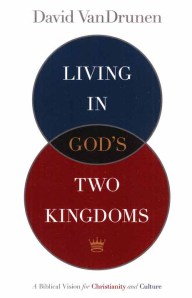
But now we might imagine that the minister prays for America’s victory in an international dispute or that the congregation is asked to sing a patriotic American song after the sermon (perhaps this Christian just happens to visit America on Fourth of July weekend). What if her own native country is the one having the dispute with America, and her own livelihood and security are at stake? What if she feels patriotic sentiments for her own country and has no interest in expressing patriotism for America? She would be unable to yield her “amen” to such proceedings, and this would be perfectly understandable – just as understandable as an American worshiping in a Russian church and feeling disinclined to pray for the triumph of Russian foreign policy or to sing patriotic Russian songs. When we are immersed in our own culture and own national interests, it is often difficult to realize how often we attach the church’s identity to a national or ethnic identity, and hence betray the spirituality of the church. The scenarios that I have imagined might cause us to pause and to reflect upon how the church can do better at living as thought there really is no Jew, Greek, Barbarian, or Scythian within its walls. (p. 149-50)

Edwards’ Resolutions

Of all things penned by the inestimable Jonathan Edwards (1703 – 1758), his “Resolutions” is one of the more widely known works alongside “Sinners in the Hands of An Angry God.” As we come into a new year (2012), it is helpful to revisit his ideas, his zeal, and his resolutions for considering how we will conduct our own lives in the time God grants to us.
Penned in a span of two years, when Edwards was himself barely out of the teenage years and just embarking on adulthood, these words stir our souls and challenge us to behold God’s grace work powerfully in our own lives.

Briefly, Desiring God lists the Resolutions according to topic and with subheadings. Steve Camp gives us a good perspective on how Edwards viewed these Resolutions as a mature man and seasoned Christian later in life.  Without any further ado, the Resolutions.

____________________________

Edwards’ Resolutions (1722 – 23)
Being sensible that I am unable to do anything without God’s help, I do humbly entreat him by his grace to enable me to keep these Resolutions, so far as they are agreeable to his will, for Christ’s sake.

Remember to read over these Resolutions once a week.

1. Resolved, that I will do whatsoever I think to be most to God’s glory, and my own good, profit and pleasure, in the whole of my duration, without any consideration of the time, whether now, or never so many myriad’s of ages hence. Resolved to do whatever I think to be my duty and most for the good and advantage of mankind in general. Resolved to do this, whatever difficulties I meet with, how many and how great soever.

2. Resolved, to be continually endeavoring to find out some new invention and contrivance to promote the aforementioned things.

3. Resolved, if ever I shall fall and grow dull, so as to neglect to keep any part of these Resolutions, to repent of all I can remember, when I come to myself again.

4. Resolved, never to do any manner of thing, whether in soul or body, less or more, but what tends to the glory of God; nor be, nor suffer it, if I can avoid it. Continue reading

Calvin on Allah & Idolatry

I’ve looked at the claims of inclusivism, universalism, and exclusivism before, but sometimes the nature Allah confuses these issues. Do Christians and Muslims worship the same g/God? Does Islam and Christianity agree for at least one Person of the Trinity? Again, Calvin is helpful here:

Christ tells his disciples to believe in him, in order that they might have a distinct and complete belief in God, “Ye believe in God, believe also in me” (John 14:1). For although, properly speaking, faith rises from Christ to the Father, he intimates, that even when it leans on God, it gradually vanishes away, unless he himself interpose to give it solid strength. The majesty of God is too high to be scaled up to by mortals, who creep like worms on the earth. Therefore, the common saying that God is the object of faith (Lactantius, lib. 4 c. 16), requires to be received with some modification. When Christ is called the image of the invisible God (Col 1:15), the expression is not used without cause, but is designed to remind us that we can have no knowledge of our salvation, until we behold God in Christ …

What I wish to impress upon my readers in this way is, Continue reading

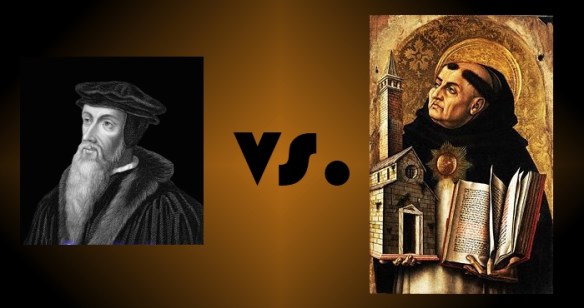
Aquinas and Calvinism

I once remember hearing that not only was the predestination of John Calvin not unique, it wasn’t even controversial among the deeper thinkers in Christian history. In fact, no less than Thomas Aquinas (1224-1274) could said to be something of a “5 Point Calvinist!”

The idea that Aquinas had a clear and strong view of predestination should be beyond dispute. No only does Aquinas’ masterpiece, Summa Theologica, contain several pertinent sections related to predestination, but Robert Mulligan translates several other relevant sections from his writings in Thomas Aquinas: Providence and Predestination (Chicago: Henry Regnery, 1953). He can say things like, “Clearly predestination is like the plan, existing in God’s mind, for the ordering of some persons to salvation. The carrying out of this is passively as it were in the persons predestined, though actively in God. When considered executively in this way, predestination is spoken of as a ‘calling’ and a ‘glorifying’, thus St. Paul says, ‘Whom he predestinated, them also he called and glorified.'” (Mulligan, 164).

But can Aquinas account as a 5 Point Calvinist? I rooted around for some quotes, and all of the following come from the Summa unless otherwise noted. Any emphasis is added by myself.

Total Depravity

“I answer that: Man’s nature may be looked at in two ways: first, in its integrity, as it was in our first parent before sin; secondly, as it is corrupted in us after the sin of our first parent. Now in both states human nature needs the help of God as First Mover, to do or wish any good whatsoever, as stated above. Continue reading

Reformation Day Lesson 2011: Standing Firm in the Faith to the End

Things have been pretty busy for myself, my church, and my family lately, so I doubt I’ll put up the whole text from our Reformation Day festivities at church, but what follows is the outline for Reformation Day conference that encouraged us to stand firm in the faith. May we all stand firm in the power He provides. “Our hope is in no other save in Thee / Our faith is built upon Thy promise free / Oh grant to us such stronger help and sure / That we can boldly conquer and endure.”

Standing Firm in the Faith
I. Introduction
A. How Scripture Exhorts Us to Stand Firm
1. And Moses said to the people, “Fear not, stand firm, and see the salvation of the LORD, which he will work for you today. For the Egyptians whom you see today, you shall never see again. (Exodus 14:13)
2. For freedom Christ has set us free; stand firm therefore, and do not submit again to a yoke of slavery. (Galatians 5:1)
3. Therefore, my brothers, whom I love and long for, my joy and crown, stand firm thus in the Lord, my beloved. (Philippians 4:1)
4. But we ought always to give thanks to God for you, brothers beloved by the Lord, because God chose you as the first fruits1 to be saved, through sanctification by the Spirit and belief in the truth. To this he called you through our gospel, so that you may obtain the glory of our Lord Jesus Christ. So then, brothers, stand firm and hold to the traditions that you were taught by us, either by our spoken word or by our letter. Now may our Lord Jesus Christ himself, and God our Father, who loved us and gave us eternal comfort and good hope through grace, comfort your hearts and establish them in every good work and word. (2 Thessalonians 2:13-17)
5. I have written briefly to you, exhorting and declaring that this is the true grace of God. Stand firm in it. (1 Peter 5:12)

B. How the Reformation Exhorts Us to Stand Firm

II. The Uniqueness of the Protestant Reformation
A. The General Consensus on the Need for Reforming the Church
B. Previous Reformation Attempts
C. What Was Unique About the Protestant Reformation

  1. Creeds vs Deeds
  2. Reformation vs Revolution
  3. New Technology – the Gutenberg Press
  4. Continue reading

Luther and the Jewish Question

Since yesterday was Reformation Sunday, our talks among the congregants eventually drifted to the question of charges of antisemitism toward Martin Luther. As a Protestant, Reformational Christian, I deeply admire Luther for what he did and accomplished, but never venerate the man nor overlook his (many) flaws and faults. His writings against the Jews are one of his flaws that we justly decry and lament. Like Zwingli’s maiden or Calvin’s handling of Servetus, these are historical instances that need to be placed in their context, condemned for what was sinful, and examples to learn from.

The first thing to remember when thinking about this subject is how Luther’s contemporaries thought about the Jewish question. In the 1530’s and 1540’s, the whole question of how to relate to Jewish people and the Judaic belief system was a highly charged and volatile issue. Writers from both the Catholic and Protestant perspectives both defended and attached Jews for everything from heresy, usury, treason and anarchy, and the ritualistic murder of children. Further, in a point that is often overlooked, there is a difference in Christians writing “anti-semite” material vs writing “anti-Judaic” material. The first attacks an ethnic people group, the second attacks a religion and belief system at odds with the claims of Christianity. The first is decidedly anti-Christian, the second is decidedly necessary for Christian apologists (see: the entire book of Galatians). Continue reading

Pascal’s Pensees and Pauline Perspective

Blaise Pascal (1623 – 62) wrote his justly famous Pensees, and perhaps one of the more well known passages is his “Wager” or “Gambit.” In part III note 233, it goes as such:

“God is, or He is not.” But to which side shall we incline? Reason can decide nothing here. There is an infinite chaos which separated us. A game is being played at the extremity of this infinite distance where heads or tails will turn up… Which will you choose then? Let us see. Since you must choose, let us see which interests you least. You have two things to lose, the true and the good; and two things to stake, your reason and your will, your knowledge and your happiness; and your nature has two things to shun, error and misery. Your reason is no more shocked in choosing one rather than the other, since you must of necessity choose… But your happiness? Let us weigh the gain and the loss in wagering that God is… If you gain, you gain all; if you lose, you lose nothing. Wager, then, without hesitation that He is.

The Wager is often expressed in the following table:

                                  Does God exist?
Yes No
Do I believe in God? Yes Eternal blessing is gained. No reward
No Eternal blessing is lost. No loss

Now here is my question. I won’t try to answer it here (perhaps in a future post). Is Pascal’s Wager above consistent with Paul’s argument below? Continue reading

Owen’s Two Definitions of Sanctification

Compare these two definitions of sanctification. The first comes from John Owen’s Works, the second from the Savoy Declaration of Faith, a document Owen, Goodwin,and many other influential congregationalist ministers had a large role in forming.

Owen’s Works, 3:386

Sanctification is an immediate work of the Spirit of God on the souls of believers, purifying and cleansing of their natures from the pollution and uncleanness of sin, renewing in them the image of God, and thereby enabling them, from a spiritual and habitual principle of grace, to yield obedience unto God, according unto the tenor and terms of the new covenant, by virtue of the life and death of Jesus Christ.

Savoy Declaration of Faith

Chapter XIII: Of Sanctification
They that are united to Christ, effectually called and regenerated, having a new heart and a new spirit created in them, through the virtue of Christ’s death and resurrection, are also further sanctified really and personally through the same virtue, by his Word and Spirit dwelling in them; the dominion of the whole body of sin is destroyed and the several lusts thereof are more and more weakened, and mortified, and they more and more quickened, and strengthened in all saving graces, to the practice of all true holiness, without which no man shall see the Lord.

What strikes you from these two definitions? The first seems to emphasize the Spirit while the second emphasizes (union with) Christ. The first mentions the imago Dei while the second mentions other facets of the ordo salutis. The first treats sin in its staining effects, whereas the latter looks at sin in its power. The first thinks of vivification in terms of “obedience” while the latter speaks of “holiness.” Only the first mentions covenant (“new covenant”), while only the latter mentions mortification. Both are clear that it is by “virtue” of Christ’s death and life/resurrection. Both are speaking of progressive, not definitive, sanctification.

So why the difference(s)? Can any Owen scholars weigh in and touch on the various emphases? Clearly, Savoy 13 is not very original to Owen or the congregationalist ministers, as it reads very similar to the WCF (click here for a comparison and scroll down). Is that the only difference here, or are there other factors at play behind these two very similar yet different definitions of sanctification?

Reformed Exclusivism

How do the various claims to truth of world religions relate to one another? Further, how should Christians think of salvation for those who have never heard? The traditional distinction to answer this question breaks into three categories:

  1. Exclusivism: Jesus is the only Savior of the world, and one must believe God’s special revelation culminating in the gospel of Christ to be saved.
  2. Inclusivism: Jesus is the only Savior of the world, but one does not have to believe the gospel to be saved.
  3. Pluralism: All paths are valid and lead to God.

Andy Naselli points to Christopher W. Morgan’s “Inclusivisms and Exclusivisms” in Faith Comes by Hearing: A Response to Inclusivism (WTS books). Morgan drills down into these categories, and notes that while most theologians still operate within these traditional sectors as a framework, in reality there are nine discernible categories:

  1. Church exclusivism: No, outside the church there is no salvation.
  2. Gospel exclusivism: No, they must hear the gospel and trust Christ to be saved.
  3. Special revelation exclusivism: No, they must hear the gospel and trust Christ to be saved, unless God chooses to send them special revelation in an extraordinary way—by a dream, vision, miracle, or angelic message.
  4. Agnosticism: We cannot know.*
  5. Continue reading

A Short Biography of Gisbertus Voetius (1589 – 1676)

Gijsbert Voet (English – Gilbert Foot) not only overlapped with Herman Witsius (1636 – 1708) for 40 odd years, but he was an important subject in the Dutch Reformed world in which Witsius lived and breathed. Not only was Witsius heavily influenced by Voetius, but Witsius’ own work was – in a sense – an attempt to reconcile the best of Voetius and Johannes Cocceius and their respective methodologies. Any careful study into Witsius must grapple with Gijsbert Voet, and hopefully the following biography presents a clear albeit brief look into this important Dutch father.

Biography of Voetius
Born in the small fortified city of Heusden as the son of Paulus Voet and Maria de Jongeling, Gisbertus (or Gijsbert) Voetius’s early years were dominated by the experience of war. Heusden was on the front line in both a military and a religious sense, as it was situated on the southern bank of the river Meuse that would later form the borderline dividing Catholic and Protestant parts of the country. Voetius’s relatives were directly involved in the conflict with Spain. Grandfather Nicolaas Dirkszoon Voet, heir to a Westphalian noble family, died in prison in ’s Hertogenbosch where he was kept on account of his support of William the Silent. Several members of Gijsbert’s mother’s family would flee the city, leaving all their possessions behind in order to accompany the Prince of Orange to Breda. Voetius’s father meanwhile saw his own property being demolished in the rampage around Heusden. Having joined the State militias for a second time in 1592, he was killed in the siege of Bredevoort in 1597, leaving behind the sickly Maria with four children. Continue reading at Witsius On the Web…