Lent Is Not For Getting Closer to God

1. Giving up food or drink or anything else cannot bring you closer to God, no matter if you do it before Easter or in the middle of September. Only Christ’s death on the cross can bring us to God (1 Peter 3:18).

2. Jesus didn’t fast for 40 days & nights in the wilderness so that you could have something to do after Valentine’s Day. He did it to “fulfill all righteousness” in redemptive history and establish Himself as the Second Adam and true Israel (Matthew 3:15).

3. Human regulations are of some value and possess an appearance of wisdom, but are powerless to bring about holiness or transformation. That is what the Gospel does (Colossians 2:20 – 23; 1:13-14).

Calvin on Lent

Then the superstitious observance of Lent had everywhere prevailed: for both the vulgar imagined that they thereby perform some excellent service to God, and pastors commended it as a holy imitation of Christ; though it is plain that Christ did not fast to set an example to others, but, by thus commencing the preaching of the gospel, meant to prove that his doctrine was not of men, but had come from heaven.

And it is strange how men of acute judgment could fall into this gross delusion, which so many clear reasons refute: for Christ did not fast repeatedly (which he must have done had he meant to lay down a law for an anniversary fast), but once only, when preparing for the promulgation of the gospel. Nor does he fast after the manner of men, as he would have done had he meant to invite men to imitation; he rather gives an example, by which he may raise all to admire rather than study to imitate him.

In short, the nature of his fast is not different from that which Moses observed when he received the law at the hand of the Lord (Exod. 24:18; 34:28). For, seeing that that miracle was performed in Moses to establish the law, it behoved not to be omitted in Christ, lest the gospel should seem inferior to the law. But from that day, it never occurred to any one, under pretence of imitating Moses, to set up a similar form of fast among the Israelites.

Nor did any of the holy prophets and fathers follow it, though they had inclination and zeal enough for all pious exercises; for though it is said of Elijah that he passed forty days without meat and drink (1 Kings 19:8), this was merely in order that the people might recognise that he was raised up to maintain the law, from which almost the whole of Israel had revolted.

It was therefore merely false zeal, replete with superstition, which set up a fast under the title and pretext of imitating Christ; although there was then a strange diversity in the mode of the fast, as is related by Cassiodorus in the ninth book of the History of Socrates: “The Romans,” says he, “had only three weeks, but their fast was continuous, except on the Lord’s day and the Sabbath. The Greeks and Illyrians had, some six, others seven, but the fast was at intervals. Nor did they differ less in the kind of food: some used only bread and water, others added vegetables; others had no objection to fish and fowls; others made no difference in their food.” Augustine also makes mention of this difference in his latter epistle to Januarius. (From Institutes 4.12.20)
John Murray on Creation as Analogical Days

From his Principles of Conduct, Murray discusses the importance of Sabbath principles. In his discussion, Murray’s language struck my ears (eyes?) as sounding similar to the language often employed when defending the analogical day view of Creation. He says:

The seventh day referred to here [Gen 2:2-BJL] is unquestionably the seventh day in sequence with the six days of creative activity, the seventh day in the sphere of God’s action, not the seventh day in our weekly cycle. In the realm of God’s activity in creating the heavens and the earth there were six days of creative action and one day of rest. There is the strongest presumption in favour of the interpretation that this seventh day is not one that terminated at a certain point in history, but that the whole period of time subsequent to the end of the sixth day is the sabbath of rest alluded to in Genesis 2:2 …. God’s week, if we may use that term, is not a cycle, it is a once-for-all accomplishment… Does this [Gen 2:3-BJL] refer simply to God’s sabbath, or does it refer to a weekly day of rest in the cycle and sequences of our time?… Even in Exodus 20:11 it is difficult to ascertain whether the sabbath referred to is expressly the seventh day in the realm of God’s activity or the seventh day in man’s weekly cycle. But the significant feature of this verse is that, whichever interpretation we adopt, the sabbath of God’s rest is the reason given for the sabbath of man’s rest, the recurring seventh day of the week. And this would carry with it the inevitable inference that God blessed and sanctified the seventh day of our week precisely because he sanctified the seventh day in the realm of his own creative activity… In the transcendent realm of God’s opera ad extra, on the grand plane of his creative action, he rested on the seventh day. God’s mode of operation is the exemplar on the basis of which the sequence for man is patterned… there is strong presumption in favour of the view that it refers specifically and directly to the sabbath instituted for man.
(emphasis original) pp. 30-32 

Now, I don’t claim to know which position Murray maintained when it comes to the Creation debate. (A quick glance at his Collected Works and Principles didn’t turn up any answers. Does anybody know? Which groups generally claim him? I was assuming he would be fairly “vanilla” on this subject.) And I’m not saying that his language here necessitates that Murray held to an Analogical Day view. But differentiating between “the sphere of God’s action” and “our weekly cycle,” and “God’s week” being a once-for-all accomplishment as opposed to the cyclical nature of “our time” does seem to put Murray as holding that the Creation Week was archetypal and our weeks are antitypical. He acknowledges the difficulty of discerning between “the realm of God’s activity” and “man’s weekly cycle” in the 4th Commandment, which would imply that the Creation Week is on another register from creaturely experience.

Again, I’m sure this language doesn’t pigeonhole Murray. In fact, he may be purposefully distancing himself from an Analogical view when he concludes that the blessed sabbath of Gen 2:3 is in fact the sabbath that humans participate in.

Is Murray a supporter of the Analogical Days view? What other position might his language support? If you find another reference, be sure to leave work and page number in the comments below!

Just In Case You Missed ‘Em

With the overwhelming influx of information available, discerning readers must become selective in what they give their time to read. Just in case you missed ’em, here are some links I found valuable, and hope you will also.

John Owen on Pastoral Prayer
Looking for further resources on how to pray better? Rev. Danny Hyde discusses Owen’s thoughts on public prayer at Meet the Puritans, including how to “improve” upon Christ’s gifts and what it might mean to “study prayer” and “pray while we study.”

Ussher on the Corporate Nature of Baptism
“Thus if we were wise to make a right use of [attending to the sacrament]; we might learn as much at a Baptism as at a Sermon.”

Apostasy Now
The always interesting Lauren Winner writes for Slate to query whether it is even possible to apostasize from mainline Christianity. “Would that America’s Protestant mainline could produce an apostate. For one might say that a group that lacks the necessary preconditions for making apostates can’t make disciples either.” Perhaps you’ve never thought it a good thing, but could you be kicked out of your church? Is there a proportionate relationship between the severity of exclusion and the warmth of inclusion?

Spiritual Alzheimers
“…when you can remember Him no more, God will remember you. ‘Even these may forget, yet I will not forget you. Behold, I have engraved you on the palms of my hands.’”

Contra Accountability Groups
Tullian says “Reminders Are More Effective Than Rebukes” when it comes to living out the Christian life.

Dennis Johnson on Preaching the Gospel
From his magnum opus Him We Proclaim, “…the same gospel that initially called us to faith is the means that perfects us in faith.”

The Bavinck Institute
A wealth of resources. How did I just now hear about this?! Download The Bavinck Review, surf for dissertations on Bavinck that may be downloaded, and find information on a debate regarding Bavinck’s view of Two Kingdoms theology.

The Fun Cult
“Entertainment is a huge American idol. Q/A #1 of the American catechism is this: ‘The chief end of man is to glorify fun and enjoy it forever.'” Bonus: great Trueman quotes on deconstruction of entertainment.

WSC: Christianity & Liberalism Revisited


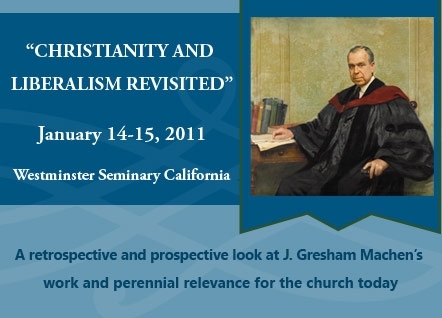
The annual conference held at Westminster Seminary, CA this year is “Christianity & Liberalism Revisited: A retrospective and prospective.” The title derives from J. Gresham Machen’s 1923 monograph which maintained that liberal Christianity was not, in point of fact, Christian at all. Machen, who would go on to establish Westminster Theological Seminary, became an important figure for confessional Christianity in the face of liberalizing tendencies. By looking backward and forward, this conference looks like a fascinating opportunity to contemplate where confessional Christianity is facing challenges and what, if anything, may be done about it. You can find out all the details at their site.

Wishing you could hear this amazing conference but can’t swing out to SoCal for the weekend? Never fear! WSC is graciously hosting the event live, and you can watch the live stream here. I’ve got my connection all warmed up. The first session begins tonight (Jan 14) at 7pm (Pacific Time).

Schedule
“Christianity and Liberalism Today” –Michael S. Horton
“The Perennial Machen” –D.G. Hart
“Machen and the Bible” –Joel. E. Kim
“Machen and the Gospel” –J.V. Fesko
“Machen and Ethics” –David VanDrunen
“Machen, Christianity, and the Church” –W. Robert Godfrey
“Q & A” -Faculty

Looks like I’ve got my viewing pleasures all mapped out for the next two days. Will you be watching?

GTD and the Lord’s Day

http://www.msnbc.msn.com/id/32545640

Visit msnbc.com for breaking news, world news, and news about the economy

David Allen was interviewed by MSNBC regarding stress and job burnout. He went over some of his standard talking points: the increased number of inputs we face today, our inability to be conscious about our various projects and NA’s, and the need to keep these out of our head and organized. One of the hosts of MSNBC suggested the importance of a vacation. The David’s response? Weekly. People need to regroup and rest on a weekly basis rather than once a year.

Further evidence for natural law, the abiding principle of the moral law, and the importance of the one-in-seven pattern laid down in Creation, covenanted at Sinai, and re-stipulated at Zion.

Though he may not put it this way, even David Allen wants you to remember the Lord’s Day, forsake not the fellowship of the saints, and regulate your worship in Covenant Renewal. Tickle that for every first day of the week.

Headline | Ames on Chastity

Featured

William Ames (1576 – 1633) was one of the important figures of the Reformation both in England and on the Continent. His Medulla Theologica (Marrow of Theology) was an important work for training ministers both in Puritan Britain as well as the Nadere Continent, and in this way his teaching connects early lights such as William Perkins with successive generations.

Ames is noted for his employment of Ramist divisions, which is a methodology that carefully considers a dialectic logic (though this claim should be carefully qualified as not embracing all accents which are associated with Ramism). Its especially helpful to see this when Ames considers “chastity.”

By carefully considering chastity in Scripture, Ames brings many qualities to light that seem all but forgotten by Christians (not to mention the world) today. Continue reading

Headline: The Marks of the Church

Featured

The Marks of the Church. Notes on the Notae to Distinguish the Bride of Christ.

Tertullian: “Those are the true churches that adhere to what they have received from the apostles.”

I was recently preparing for a Consistory meeting and we were going to talk about the third mark of the Church, and as I was preparing I started noticing diversity amongst some of our Reformed fathers. Wanting to understand a bit better the exegetical basis for some of the different decisions, I began to catalog various confessional documents and theologians on the matter. I thought others might find it useful to see these findings placed side by side, and so you will find them below in chronological order. No doubt, others ought to be added to this list, and if there is anyone of particular importance that ought to be cataloged, either for their uniqueness or influence, leave a note in the comments and I’ll try to track them down and add them to the list.
Continue reading

J.I. Packer’s Introduction to Owen’s Death of Death

“Introductory Essay”
to John Owen’s Death of Death in the Death of Christ
J. I. Packer
_________________________________________________
I.

The Death of Death in the Death of Christ is a polemical work, designed to show, among other things, that the doctrine of universal redemption is unscriptural and destructive of the gospel. There are many, therefore, to whom it is not likely to be of interest. Those who see no need for doctrinal exactness and have no time for theological debates which show up divisions between so-called Evangelicals may well regret its reappearance. Some may find the very sound of Owen’s thesis so shocking that they will refuse to read his book at all; so passionate a thing is prejudice, and so proud are we of our theological shibboleths. But it is hoped that this reprint will find itself readers of a different spirit. There are signs today of a new upsurge of interest in the theology of the Bible: a new readiness to test traditions, to search the Scriptures and to think through the faith. It is to those who share this readiness that Owen’s treatise is offered, in the belief that it will help us in one of the most urgent tasks facing Evangelical Christendom today—the recovery of the gospel. Continue reading