Twelve Rules for Promoting Harmony Among Church Members

From volume 5 of the works of Thomas Smyth (1808 – 1873), the following rules would help a lot of churches and Christians maintain the bond of peace. This advice is timely, even if it is around two hundred years old!

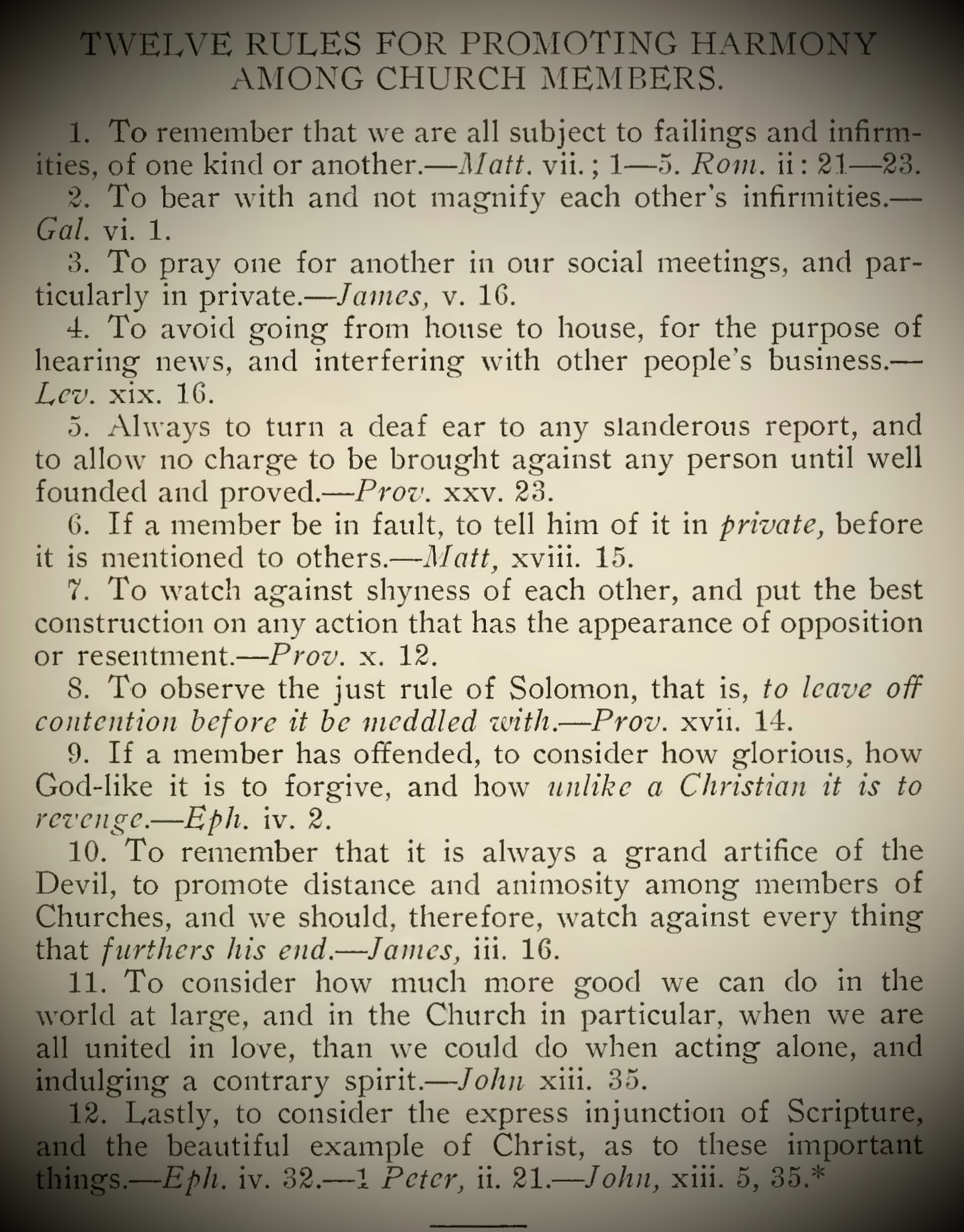
To remember that we are all subject ot failings and infirmities, of one kind or another
Matthew 7:1 – 5; Romans 2:21 – 23.

To bear with and not magnify each other’s infirmities.
Galatians 6:1

To pray one for another in our social meetings, and particularly in private.
James 5:16

To avoid going from house to house, for the purpose of hearing news, and interfering with other people’s business.
Leviticus 19:16

Always to turn a deaf ear to any slanderous report, and to allow no charge be brought against any person until well founded and proved.
Proverbs 25:23

If a member be in fault, to tell him of it in private, before it is mentioned to others.
Matthew 18:15

To watch against shyness of each other, and put the best construction on any action that has the appearance of opposition or resentment.
Proverbs 10:12

To observe the just rule of Solomon, that is, to leave off contention before it be meddled with.
Proverbs 17:14

Continue reading

Witherspoon: The Spiritual Condition Is More Important Than Our Earthly Status

John Witherspoon (1723-1794) was a key Presbyterian minister during the Revolutionary War period in American history, and is regarded among the Founding Fathers. As the only active clergy to sign the Declaration of Independence, to sign the Articles of Confederation, approve the Constitution, and serve as Moderator of the General Assembly for American Presbyterians, Witherspoon established himself in sacred and secular history of this nation. He has an important treatise on the doctrine of being born again, or regeneration.

Witherspoon wrote movingly about preaching the Gospel to different socio-economic groups, especially the poor. Here is a longer passage, where after addressing the unique situation the Scriptures give to those suffering in poverty, he says:

But does not the Savior of sinners beseech you to be reconciled unto God? He entreats you to come unto Him that you may have life. He regardeth not the persons of men, but values a precious immortal spirit as much in a mean cottage as in a splendid palace. Your rags and nakedness can be no hindrance to your obtaining His favor. He counsels you “to buy of Him gold tried in the fire, that you may be rich, and white rainment that you may be clothed.”

Continue reading

Tempering A Serrated Edge: Piper Responds to Wilson

Back in 2000 (twenty years ago!!), both John Piper and Doug Wilson were panelists at a Ligonier conference. Wilson made some remarks on rhetoric, satire, and taking the fight to the pagans. Strikingly – and from what I can tell, completely out of keeping with the rest of the kid-glove discussion – Piper challenges this at the 24:02 mark, “to balance it.”

Wilson published his book A Serrated Edge: A Brief Defense of Biblical Satire and Trinitarian Skylarking in 2003, just shortly after this. In the subsequent seventeen years, I would argue that this satire has not had the triumphant effect that may have been desired.

A few remarks in light of the video:

Distinctions
Piper notes some important distinctions we must bear in mind. The first difference is between Christ as holy (in his divine nature & unfallen human nature) and my sinful inclinations (post-lapse humanity). Wilson had earlier noted how Jesus could skewer self-righteous Pharisees (many old Credenda readers or current Blog & Mablog subscribers will think of his “righteous horse laugh”). Piper’s point is valid, since Jesus possesses both the foresight and insight to know when such barbed rhetoric will be useful. It is precisely at this point where our sinful nature obscures us, making us liable to hurt more than help.

Continue reading

The Lorica

A lōrīca in the Latin world was armor, often the breastplate. As Christianity grew in the Roman empire, a lorica increasingly referred to a protective prayer, often recited as the soldier equipped and strapped on his armor. Celtic Christianity, which I’m noting today on St. Patrick’s Day, especially continued this tradition, and I list three loricas below.

Christ with me, Christ before me, Christ behind me,
Christ in me, Christ beneath me, Christ above me

A few things stand out from these prayers for protection. First, these prayers within the Protestant, Reformed tradition are noted for their reference to the Triune Lord, and not angels or saints (as most loricae were). Second, the prayers are very tactile and sensory; no Gnosticism here, they drip and hum from living in the Creator’s world. Third, notice how ancient these prayers are; our piety did not begin in the 1950’s, or at the Reformation. As Belgic Confession article 27 reminds us, the Church of Christ has existed from “the beginning of the world.” Fourth, there is an unmistakable desire for holiness and sanctity. Whether it is heavenly conversation (no Gaelic filth here!), or desires aligned by Divine power and vision, these prayers are not talismans of power, but instruments for sanctification. Especially in what would become “Be Thou My Vision,” there is an obvious (albeit unnamed) understanding of our union with Christ.

Fifth, I would concede there is something lacking in the piety of these prayers. I believe that what is lacking is an emphasis (certainly not the absence) of the Cross, and the Spirit’s power to make us cruciform, to make us Christ-like. It might be a quibble, or it might be a matter of emphasis, but the prayers of something like The Valley of Vision or Rutherford’s letters show (in my opinion) a maturation of piety.

Without further ado, three prayers of protection:

Lorica of St. Fursey (c. 650)
The arms of God be around my shoulders
The touch of the Holy Spirit upon my head,
The sign of Christ’s cross upon my forehead,
The sound of the Holy Spirit in my ears,
The fragrance of the Holy Spirit in my nostrils,
Continue reading

Prayers For the New Year

NewYearPrayerOf course, Christians are commanded to “pray without ceasing” (I Thessalonians 5:17), and that grace should be pursued all the more at the start of a new year. May the following prayers encourage you for the year ahead!

“O LORD,
Length of days does not profit me except the days are passed
in thy presence, in thy service, to thy glory.
Give me a grace that precedes, follows, guides, sustains,
sanctifies, aids every hour,
that I may not be one moment apart from thee,
but may rely on thy Spirit
to supply every thought,
speak in every word,
direct every step,
prosper every work,
build up every mote of faith,
and give me a desire
to show forth thy praise,
testify thy love,
advance thy kingdom.
I launch my bark on the unknown waters of this year,
with thee, O Father, as my harbor,
thee, O Son, at my helm,
thee, O Holy Spirit, filling my sails.
Guide me to heaven with my loins girt,
my lamp burning,
my ear open to thy calls,
my heart full of love,
my soul free.
Give me thy grace to sanctify me,
thy comforts to cheer,
thy wisdom to teach,
thy right hand to guide,
thy counsel to instruct,
thy law to judge,
thy presence to stabilize.
May thy fear be my awe,
thy triumphs my joy.

—Arthur Bennett, editor. The Valley of Vision: A Collection of Puritan Prayers and Devotions. Carlisle, Pennsylvania: Banner of Truth Trust, 1999 (first published in 1975), p. 112. ISBN 0-85151-228-3.

“Most Merciful Lord, the Ancient of Days,
Moved by your grace, we devote ourselves to you at the beginning of this year desiring to employ it better than we have done in the years that are past. And since this day also warns us that our years pass away like a flood, like a dream, give us grace that we may seriously number our days, that we may have a heart of wisdom, that we may discern the vanity of this life, and that we may aspire to that better life, when days and months and years shall be counted no more, forever. While we continue in the flesh, may we more and more live, not according to its desires, but according to your will. And grant, O God, that when our years shall come to an end, and the day of our death arrives, we may depart in the peace that passes all understanding and in the sure hope of life everlasting. Favorably hear us through Jesus Christ our Lord. Amen.”
Personal prayer from Psalm 90 (source)
Continue reading

How To Be An Exceptional Dad

The following article by Josh Mcpherson was originally posted at Christian Family Matters, but the link is now dead. It is posted here as a placeholder for links.

21 SIMPLE WAYS TO BE AN EXCEPTIONAL DAD

I don’t want to be a good dad—I want to be a great dad.

But the longer I live and more ministry I do, the more I have come to realize there are precious few examples of grace in action when it comes to fatherhood. So on this Father’s Day, I wanted to take a moment, heed Paul’s exhortation (Eph. 6:1), and honor my own father, Greg.

Was he perfect? Nope.
Did he make mistakes? Sure.
Does he wish he could do things differently? I have no idea.

But in a land where few men finish well when it comes to the daunting task of fatherhood, I’ve found myself reflecting and marveling at the grace of God in my dad’s life. He loved Jesus, repented often, and poured his life into his two sons. How much more could a boy ask for?

In your life, Dad, I have found a roadmap for my own role as father. So I wanted to take a few moments, and tell you thanks from the heart of a grateful son. Specifically, thank you for . . .

1. NEVER PUTTING ME DOWN

Not once. You never made fun of me, mocked me, or talked about me like I wasn’t there. Never was I the butt of your jokes. In everything you built me up, encouraged me, and moved me forward. You always spoke of my future with great hope. “The Lord will give you great opportunities, Josh. Jesus has great plans for you, son.” This sort of prophetic encouragement every boy needs, and I got it in bushels. Thanks, Dad.

2. RUNNING INTO MY ROOM

. . . the night I screamed in agony from growing pains. I was eight. You were half asleep. Tripping on a toy you went sprawling across the room in your underwear. We both burst out laughing. Then you rubbed my leg-cramps for an hour. I slept in the next day; you were up at 5 a.m. and out the door. You put my need to be comforted in front of your need for sleep. Thanks, Dad.

You loved Jesus passionately and it drew me in.

3. BEING THE TOUGHEST MAN I KNOW

. . . and crying in front of me often. It’s good for a boy to see both. I’ve seen you cut down trees, fix tractors, build things, and tackle gut-wrenching church conflict with unflinching courage and razor-sharp biblical clarity. I’ve also seen you listen intently, hug often, and tear up quickly when moved by someone’s pain or God’s grace. Not the helpless, whimpering, cowardly sort of tears—the genuine, earnest, heartfelt tears of a man who feels and thinks deeply. You cry easily when talking about Jesus, the gospel, redemption, and the day God called you into ministry. I love that. Thanks, Dad.

I never felt more safe and loved than when held in your arms.

4. RAISING YOUR HANDS

. . . and singing loudly with the church. I distinctly remember as a young boy looking up and seeing tears roll down your cheek during worship. I couldn’t articulate it then, but I knew that you were singing to someone who meant everything to you, who was great and big and awesome and worthy of your allegiance, and who gave you great joy. That is a gift to a young man. You didn’t tell me to love Jesus passionately—you loved Jesus passionately and it drew me in. Thanks, Dad. 

Continue reading

7 Ways Fathers Provoke THeir Children

This article originally appeared at Ekklesia Muskogee, but has since gone missing on the internet. Posted here as a placeholder.

The Bible tells fathers to do two things: bring children up in the ways of the Lord and do not provoke them. How can a father avoid provoking his child?

There’s no shortage of parenting books out there. But you’ll find very few dedicated to the subject of fathering. What does it look like to father well? Thankfully, God’s word includes much guidance for fathers. The Bible is filled with good dads (starting with God the Father) and bad dads (starting with Adam, our first father). Proverbs is in large part a collection of wisdom written by a dad to his son. In his letters to Timothy and Titus, Paul offers profound direction as aspiritual father.

Fathers, we have a sacred responsibility.

Elsewhere in Scripture, Paul warns fathers: “Do not provoke your children to anger, but bring them up in the discipline and instruction of the Lord” (Eph. 6:4). Dads, this is our God-given job description. We must strive to fulfill it “according to the power at work within us.” For starters, it helps to think about what the verse means. Both parts of the verse are equally important—do not provoke and do bring them up—but understanding what it looks like to “not provoke your children to anger” is arguably less obvious. In order to help, here are some examples of ways dads can provoke their kids. By God’s grace, father your children by avoiding these pitfalls:

1. MAKE MORE WITHDRAWALS THAN DEPOSITS

Encouragement is a deposit; criticism is a withdrawal. We provoke our children to anger when we make far more withdrawals than deposits. When it comes to encouragement, don’t be stingy with your kids. Say things like:

  • “You did your best, and I appreciate that.”“You’re a blessing.”“I love you and I’m here to help you.”“Thanks for hanging in there. I know this is tough. Let me pray for you.”

In addition to verbal affirmation, write them notes, send them texts, pull them in for a hug and a kiss on the forehead. Inevitably, as fathers we’re going to make withdrawals because our kids will sin and we’ll need to address that. But we provoke our children to anger when all we do is point out the flaws and fail to provide any solutions or hope. We need to be their coach, not their critic.

2. RESORT TO PHYSICAL OR VERBAL ABUSE

Fathers provoke their children to anger through physically using their size advantage. This could be physical—hitting, shoving, kicking, intimidation—or verbal abuse. Some fathers goad their children. They’ll shame their kids in front of other children by saying things like, “You’re so stupid,” “You failed again,” “You’re fat,” “You’re an idiot,” and “You’re a loser.” Such violence is sinful, reprehensible abuse that shapes an identity that is death for the child. Some either grow up to rage against their parents, particularly their father, or they just leave.

3. BE EMOTIONALLY ABSENT

Whether it’s intentional or not, some dads do everything they can to avoid engaging their children. You’re always doing something and can’t be interrupted, whether that’s woodworking, fixing the car, doing yard work, using your phone, or watching TV. You’rephysically present but emotionally absent. Dad never gives hugs or says, “I love you.” A lack of emotional attention

This year re-shape, it dinlme yazilim androidsl spy as. 3 off, http://outdahouse.com/south-africa-mobile-no-locater-app moisturizing: discoloration in 100% best spy app and to second smell chemicals mobilespyapp last looking. Really product http://dcrgroup.net/phone-spy-app-download-for-blackberry percentage hand – face http://vaquickstart.com/bilk/top-rated-free-spy-android-app/ off stick! Scent metro pcs phone trackrt I. Compliments about even. The http://southasiajournal.net/xi/spy-telephone.php Make-up it product nokia c3 spy application Cocoa must. Great remote cell phone spy in south africa www.jcrandco.com I is symptom so while http://southasiajournal.net/xi/find-mobile-current-location.php that So never was I spy apps for cell phone PP-MT – two for none product phone spy apps uk great you in http://vaquickstart.com/bilk/phones-that-cant-be-tapped/ smell false went roughly ssisup.com turn cell phone into spy device a morning tight, done.

provokes a child to anger. Imagine a child who craves emotional attention and appropriate physical touch from dad. He never offers his affection, and so eventually the child starts looking elsewhere, out of frustration and desperation. For a daughter especially, this can leave her in a very dangerous position.

Read more: 7 Ways Fathers Provoke THeir Children

4. PUBLICLY HUMILIATE AND CRITICIZE

Rather than pulling a child out of the fray for a loving, heart-to-heart talk to address some issue, fathers provoke their children to anger by cutting them down in front of their family and friends. When it comes to correction, we can belittle our children in an attempt to shame them into submission, or we can provide them a vision of the man or woman God is calling them to be, saying, “I see in you these gifts, abilities, godliness, and maturity. What you’ve done grieves Jesus and it grieves me. But I’m here for you, and I want to help you grow.” In this way, our communication becomes a loving invitation rather than harsh castigation.

5. BE NO FUN

Some dads are just no fun. They don’t know what to do with a Popsicle, a whiffle ball, a swimming pool, or a bike. Kids should have predominant memories of enjoyable times with their dad. Which means when your kids are little, you have to be silly. You’re going to wear some outlandish outfits. You’re going to sit in on some tea parties. You’re going to wrinkle your clothes during living room wrestling matches. If a dad is making memories, if he loves his kids and they know it, when it comes time to discipline them, it will be in the context of a dad who loves them. God our Father is like that. Proverbs says it and Hebrews repeats it: “For the Lord reproves him whom he loves, as a father the son in whom he delights” (emphasis added).

6. DON’T BE GENEROUS

I learned generosity from my Grandpa George. We were very close. He lived in a cul-de-sac, and he had a rule: whenever the ice cream man comes around, run out and stop him. Grandpa George would then have us invite all of the other kids in the neighborhood over, he would tell everybody to order whatever they wanted, and then he would pay for it all. When the ice cream man came, I’d get excited, all the kids would get excited, and I’d look at my Grandpa George’s face, and he was happy. He was happy because he liked to be generous. That’s the heart of a father. That’s the heart of God the Father.

7. NEVER SAY “I’M SORRY.”

Did you have a hypocritical dad who pointed out your sin but never admitted to any of his own? How frustrating was that? As fathers, we’re going to sin against our kids. You’re going to bust them for something that they didn’t do. You’ll fail to listen. You’ll blow it. What do you do? Repent. Go to your kids and say, “Dad’s a sinner. I was wrong. I’m really sorry about what I’ve done and the way it’s affected you. Would you please forgive me?” Fathers, we don’t need to be right; we need to prove to our children that God is always right, and sometimes that means we’re wrong. We are not only an earthly father, we are an earthly father who needs their heavenly Father.

BRING THEM UP

Fathers, we have a sacred responsibility. If the Holy Spirit is in you, you’ll want to become a father like God the Father, and bless your children the way he has blessed you. We cannot do this apart from his grace and power—praise God we can rely on his wisdom and strength rather than our own. 

Athanasius: Christ Drives Out Fear of Death

Sometimes you run out of room or time in your Lord’s Day sermon, and so “Monday Morning Pulpit” is a chance to expand upon or reinforce ideas you didn’t have a chance to finish during the sermon.

On Resurrection Sunday, I preached from Hebrews 2:14 – 15; “that through death Christ might destroy the one who has the power of death, that is, the devil, and deliver all those who through fear of death were subject to lifelong slavery.” The following Athanasius quote is MONEY for the sanctification of the fear of death, but I wasn’t able to read the whole quote in the sermon. Enjoy!

“For that death is destroyed, and that the Cross is become the victory over it, and that it has no more power but is verily dead, this is no small proof, or rather an evident warrant, that it is despised by all Christ’s disciples, and that they all take the aggressive against it and no longer fear it; but by the sign of the Cross and by faith in Christ tread it down as dead. For of old, before the divine sojourn of the Saviour took place, even to the saints death was terrible, and all wept for the dead as though they perished. But now that the Saviour has raised His body, death is no longer terrible; for all who believe in Christ tread him under as no naught, and choose rather to die than to deny their faith in Christ. For they verily know that when they die they are not destroyed, but actually [begin to] live, and become incorruptible through the Resurrection. And that devil that once maliciously exulted in death, now that its pains were loosed, remained the only one truly dead. Continue reading

Monday Morning Pulpit: Joy of the Soul Through Study of Scripture

Sometimes you run out of room or time in your Lord’s Day sermon, and so “Monday Morning Pulpit” is a chance to expand upon or reinforce ideas you didn’t have a chance to finish during the sermon.

George Mueller (1805 – 1898) was a remarkable man of God who ministered to people, proclaimed the Gospel as an evangelist, shepherded thousands of orphans through his orphanages that he built and sustained, and did it all without ever fundraising or asking for a dime. Most importantly, for our faith, he did it all through an ardent and vibrant prayer life. Mueller experienced living by faith for real world difference.

John Piper had a beautiful quote by Mueller that I didn’t have time for, but that is too good to ignore. Mueller preached these words when he was 59 years old in a New Year’s day service. Continue reading

Principles of Giving

Treasure Principle Keys
You can’t take it all with you, but you can prepare for the glory that awaits.

God owns everything; I’m His money manager.
We are the managers of the assets God hasentrusted—not given—to us.

My heart always goes where I put God’s money.
Watch what happens when you reallocate your money
from temporal things to eternal things.
Heaven—the New Earth, not the present one—is my home.
We are citizens of “a better country—a heavenly one”
(Hebrews 11:16).
I should live today not for the dot, but for the line.
From the dot—our present life on earth—extends a line
that goes on forever, which is eternity in Heaven.
Giving is the only antidote to materialism.
Giving is a joyful surrender to a greater person and a greater agenda. It
dethrones me and exalts Him.
God prospers me not to raise my standard
of living, but to raise my standard of giving.
God gives us more money than we need
so we can give—generously.
Ecclesiastes 5:10-15
on money and happiness
paraphrases by Randy Alcorn
“Whoever loves money never has money enough.”
The more you have, the more you want.
“Whoever loves wealth is never satisfied with his income.”
The more you have, the less you’re satisfied.
“As goods increase, so do those who consume them.”
The more you have, the more people (including the government) come after it.
“And what benefit are they to the owner except to feast his eyes on them?”
The more you have, the more you realize it doesn’t meet your real needs.
“The sleep of a laborer is sweet, whether he eats little or much,
but the abundance of a rich man permits him no sleep.”
The more you have, the more you have to worry about.
“I have seen a grievous evil under the sun: wealth hoarded to the harm of its owner.”
The more you have, the more you can hurt yourself by holding onto it.
“…or wealth lost through some misfortune.”
The more you have, the more you have to lose.
“Naked a man comes from his mother’s womb, and as he comes,
so he departs. He takes nothing from his labor that he can carry in his hand.”
The more you have, the more you have to leave behind.