
“Backsliding generally first begins with neglect of private prayer.” – JC Ryle
Liberal, ahistorical Scholastics?
1
In a Mars Hill Audio interview, Ellen Charry observes that the Protestant theologians of the seventeenth century, even before the Enlightenment, had a tendency to detach truth from historical reference. The truth of theology was seen in the coherence of the system of truth found in Scripture, rather than a truth of reference to historical events.
Charry’s comment was a passing one, no doubt a drastic oversimplification. Protestant scholastics, after all, defended the historical reliability of Scripture as well as its systematic coherence. But, the comment seems worthy of investigation, since it might provide a historical link between Protestant scholasticism and the development of liberal theology.
Maybe there is some truth to this claim, especially since “the Protestant theologians of the seventeenth century” (no reference to confessional position, orthodoxy, etc.) is a pretty wide generalization. I didn’t listen to the interview, and like Leithart noted, it was a passing comment.
That said, there are important nuances to this idea. If by “Protestant theologians of the seventeenth century” one is referring to Reformed Scholastics like Cocceius, Voetius, Brakel, Turretin, Owen, or Witsius, then qualifications should be noted. These qualifications follow in patterns that we, and Charry?, may not quickly set upon. First, the scholastics (and Protestant scholastic era) were some of the best with historically-referent theology, and secondly, despite their connections with history, some of these theologians were quickest into the liberal slide. Continue reading
Link
Link
Link
Link
Be Careful How You Hear
Dear Zion,
One of the things a pastor and a congregation spend a lot of time on together is the sermon that is preached every Lord’s Day in the worship service. The minister spends time preparing and delivering the message, and the congregation spends time hearing it and living their lives based off of it. But have you ever thought about how to hear a sermon? How can we obey Jesus’ command to “be careful how you hear” (Luke 8:18)? Consider a few ideas with me:
- Believers should prepare themselves to hear. The Apostle Peter commands that we “desire the sincere milk of the Word like newborn babies,” and that one of the ways we prepare that spiritual “thirst” within us for God’s Word is by laying aside all sin (I Peter 2:1 – 2). Sin acts like wax in our ears, and keeps us from hearing the life-giving words we so desperately need. Do not allow Saturday night – or the week before Sunday – as an opportunity for sin, but instead lay aside sin by faith and focus on “thirsting” to hear from the Lord in the sermon.
- Believers should prepare through prayer. Continue reading
gotta shake this sore throat
Status

gotta shake this sore throat
Redemptive Historical Preaching: Christ at the Center
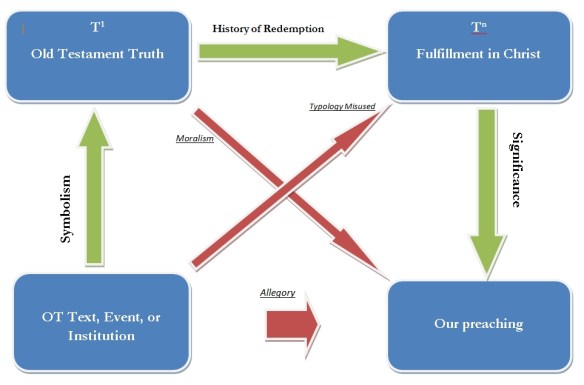
One concept that is so helpful to have when considering how to exhort God’s people from God’s Word is that our preaching must be Christ-centered. The idea that Scripture isn’t just a book of timeless truths, morality plays, or helpful advice for living, but is instead one grand narrative displaying the promise of, the coming of, and the rule of the Messiah Jesus, has been thoroughly covered by men much better than I, most notably Ed Clowney, Sidney Greidanus, Dennis Johnson, and Graeme Goldsworthy. Their articles and books are most helpful. But occasionally, just having a handy chart around can jog your mind in the specifics.
The above chart can be downloaded here. It is a rough adaption of what Dennis Johnson adapted from Ed Clowney. I’ll try to briefly explain what the chart says, as well as how to use it below. Continue reading
 Brian J. Lund